
Intent-Based Protocols Explained 2026: CoW Swap, Across, UniswapX, Anoma
Intent-based architectures are quietly replacing transaction-based DeFi. How solver auctions work, why they beat traditional swaps and bridges, and the protocols shaping the shift — CoW, Across, UniswapX, and Anoma.
WELC Team
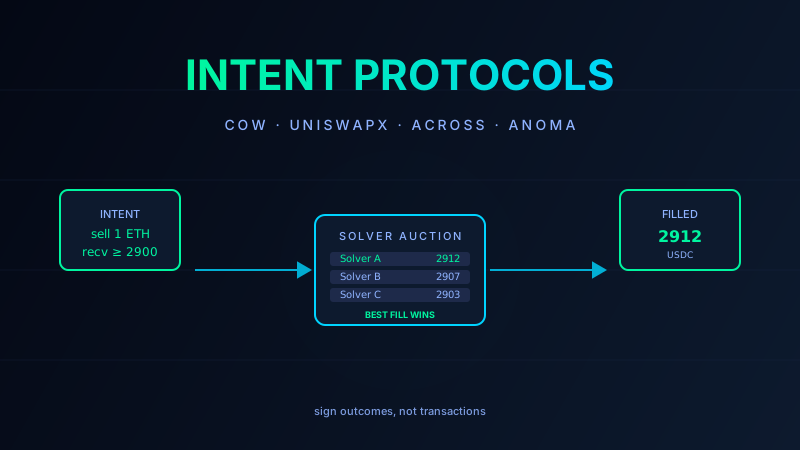
For most of DeFi's history, using a protocol meant describing to the blockchain exactly what you wanted to happen: swap this token for that one through this specific pool, bridge these funds across this specific bridge, repay this debt before that liquidation. Every transaction was a recipe. If the recipe went stale in the 12 seconds between signing and confirmation — because gas changed, because MEV bots front-ran, because the pool shifted — too bad.
Intent-based protocols invert this. You describe the outcome you want, sign it, and let a competitive market of solvers figure out how to deliver it. Don't sell your ETH on Uniswap specifically — just tell the world you want to receive at least 2,900 USDC for 1 ETH, and whoever can hit that number most profitably wins the right to execute.
That inversion is now shaping a meaningful share of DeFi volume. CoW Swap, Across, UniswapX, 1inch Fusion, and a growing list of intent-native protocols are processing billions of dollars of user flow where the user never specifies a route. This guide explains how intents work, why they're structurally better than transactions, and which protocols you should know in 2026.
TL;DR
- An intent is a signed statement of desired outcome — "give me at least X output for Y input" — rather than an imperative transaction instruction
- Solvers compete in auctions to fill intents, pocketing any surplus they can capture between the user's reservation price and the actual market
- Users get better execution because solvers do the route-finding, MEV internalization, gas optimization, and cross-chain routing that users previously had to guess at
- The core live protocols are CoW Swap (batch auctions, original intent system), UniswapX (open Dutch-auction orderflow), Across (cross-chain intents), 1inch Fusion (Dutch-auction swaps), and Anoma (intent-native L1 infrastructure)
- The economic trade is that solvers are a new middleman — users gain execution quality, but a fraction of value that previously went to MEV now goes to solver profits
- Watch in 2026: solver centralization, intent-native infrastructure deployments, and whether intents eat the cross-chain bridging category entirely
Transactions vs Intents — The Architectural Difference
A traditional DeFi transaction looks like this:
call UniswapV3.swap(
  tokenIn: WETH,
  tokenOut: USDC,
  fee: 0.05%,
  amountIn: 1 ETH,
  amountOutMin: 2900 USDC,
  recipient: 0xUserWallet,
  deadline: block.timestamp + 60
)
The user (or their wallet's router) has pre-committed to:
- Which protocol to use (Uniswap V3)
- Which pool to route through (the 0.05% fee tier)
- A specific minimum output
- A specific deadline
Every one of those decisions has to be correct at the moment of execution. If the 0.05% pool is not the best path when the block is mined, the user gets a worse price. If the deadline is too tight, the transaction reverts. If an MEV bot sees the transaction in the mempool, it might sandwich it.
The intent version is simpler:
intent {
  sell: 1 ETH
  receive_at_least: 2900 USDC
  before: 2026-04-18T14:30:00Z
  allowed_solvers: any
}
The user has told the system what they want. They have not told it how to achieve it. A solver then figures out the actual route — maybe it's Uniswap, maybe it's Curve, maybe it's a solver's private inventory, maybe it's a cross-chain path — and delivers the promised output in exchange for a fee.
That's the architectural shift. Everything else is implementation.
Why Intents Win on Execution Quality
A competitive solver market ends up delivering better outcomes than self-routed transactions for four reasons:
1. Solvers aggregate across venues the user cannot. A solver can combine Uniswap liquidity with their own private inventory, with a market maker's OTC quote, with Curve, with Balancer, with an incoming order from another user that happens to want the opposite trade. A user's wallet router typically cannot.
2. Batch auctions internalize MEV. In CoW Swap's model, orders are collected into batches and cleared simultaneously at a uniform price. This neutralizes the ability of searchers to extract value from individual orders — sandwich attacks do not work when orders are batched.
3. Solvers can wait. An intent can specify a deadline hours in the future. A solver might hold the intent and execute when market conditions are best, rather than at the random moment a user's transaction got included.
4. Cross-chain intents hide the bridge. Instead of the user picking a bridge, waiting for a 15-minute finality window, and then swapping on the destination chain, the solver handles the entire cross-chain path in seconds using their own capital.
The economic consequence is that execution quality in intent-based flow routinely beats a same-second Uniswap swap by meaningful basis points on larger orders. The cost is that solvers capture some surplus — but a shared surplus beats an MEV bot's unilateral capture every time.
The Protocols That Matter Now
CoW Swap
The original serious intent protocol. CoW (Coincidence of Wants) launched in 2021 with the insight that when two users want opposite trades at roughly the same price, a smart settlement system can match them directly — skipping the on-chain pool entirely and avoiding paying fees to anyone.
How it works:
- Users submit signed off-chain orders
- Orders are collected into batches (typically ~30 seconds)
- Solvers compete to propose the best clearing solution for the entire batch
- The winning solver executes and receives a reward in COW tokens
- Orders are settled at a uniform clearing price
Why it's different:
- Uniform batch pricing eliminates sandwich attacks
- Direct CoW matching cuts cost when opposite orders coexist
- Best execution often beats single-venue DEXs on size
2026 status: Consistently processes billions in monthly volume. Preferred by DAOs and treasury desks for large swaps. Integrated into Safe, Rabby, and most serious DeFi frontends.
UniswapX
Uniswap's intent product, launched in 2023 and substantially expanded through 2024–2025.
How it works:
- Users sign a Dutch auction order — a price curve that starts favorable and walks toward a worse-case fill price over time
- Solvers ("fillers") watch the orderflow and fill orders when the auction reaches a price they're willing to take
- Includes cross-chain support — UniswapX can bridge from chain A to chain B as part of fulfilling an intent
Why it's different:
- Explicit Dutch auction makes price discovery transparent
- Filler network is open — anyone can become a filler and compete
- Deep integration with the Uniswap interface means huge user distribution
2026 status: Major share of Uniswap volume now goes through UniswapX rather than direct AMM swaps. Cross-chain intents are maturing into a competitor to pure bridges.
Across
An intent protocol specialized for cross-chain transfers.
How it works:
- User signs an intent: "send N of token X from chain A to chain B, receive at least M"
- Relayers front the user's funds on the destination chain immediately, taking a fee for the service
- The relayer is later reimbursed from chain A via Across's canonical bridging path
- User experience: sub-minute cross-chain transfers
Why it's different:
- Speed — relayers front capital so users don't wait for canonical bridge finality
- Capital efficiency — relayers run sophisticated inventory management across chains
- Clean security model — users trust Across's settlement contracts, not a multisig
2026 status: Dominant intent-based bridging protocol, processes billions in cross-chain volume. Competing directly with Stargate, Hop, and Circle's CCTP for user bridging volume.
1inch Fusion
1inch's intent product, competing directly with UniswapX.
How it works:
- Users sign Dutch auction orders
- A resolver network competes to fill
- Includes 1inch's own routing intelligence across all DEXs
Why it's different:
- Deep aggregator heritage — 1inch has years of experience routing across every DEX
- Strong presence across multiple chains and L2s
- INCH token incentives layered on top of execution
2026 status: Meaningful share of aggregator volume. Less branded visibility than UniswapX but strong execution in many corridors.
Anoma
The most architecturally ambitious intent protocol — an entire L1 built intent-first.
How it works:
- Anoma is a blockchain where every user interaction is an intent, not a transaction
- Validators (called "solvers" in Anoma's parlance) match and execute intents atomically
- Supports complex multi-party intents (e.g., "I'll pay X if Alice pays Y and Bob pays Z, all or nothing")
- Privacy-preserving by design — intents can be shielded
Why it's different:
- First-principles redesign of blockchain execution around intents rather than transactions
- Natural support for barter, multi-party coordination, and atomic multi-step DeFi
- Serious cryptography team (Namada, Heliax)
2026 status: Namada (the privacy-focused member of the Anoma ecosystem) is live. Anoma mainnet is rolling out its full intent infrastructure. The vision is compelling; the adoption race is early.
The Economic Reality of Solver Markets
Intents trade one middleman (MEV bots extracting value from individual transactions) for another (solvers capturing profit from filling intents). Whether this is net-positive for users depends entirely on how competitive the solver market is.
In a competitive solver market:
- Many solvers compete on price
- Solver margins compress to cover real costs plus a thin profit
- Users capture most of the gross execution improvement
In a concentrated solver market:
- Few solvers control most flow
- Solver margins widen into rent extraction
- Users capture less of the improvement
The three main intent protocols (CoW, UniswapX, Across) all actively work to keep solver markets open — public auction results, permissionless solver onboarding, transparent rewards. The honest concern is that sophisticated solver operations increasingly require proprietary infrastructure (private order flow from wallets, co-located market maker inventory, multi-chain capital deployment), which naturally concentrates the market.
Early 2026 data suggests solver markets are still reasonably competitive, but the trend warrants watching.
Why Wallets Are the Hidden Battleground
The entity that actually builds intents on behalf of a user is the wallet or frontend they use. When you open MetaMask and hit "swap," something in the software stack decides whether to route through a traditional DEX, CoW Swap, UniswapX, 1inch Fusion, or direct inventory.
That routing choice is becoming a business. Wallets can sell order flow to specific solvers or aggregators — a familiar arrangement from traditional finance's payment-for-order-flow (PFOF) model. In DeFi, PFOF is quietly live: some wallets receive rebates from specific aggregators for routing user swaps through them, and the user may or may not see this.
Good outcomes for users require:
- Transparent disclosure of any order flow arrangements
- Access to open auction routes, not just routed-to-one-solver paths
- Wallets that benchmark execution across multiple intent protocols
The frontier in 2026 is wallets that can execute a user's intent by submitting it to all major intent protocols simultaneously and routing to whichever fills best. A few (Rabby, Zerion, Matcha) are building toward this explicitly.
What to Watch Through 2026
- Share of DEX volume going through intents — crossing 50% would mark a decisive architectural shift; we're in the 30–40% range and rising
- Solver consolidation — top solver concentration is the main metric for whether the model stays honest
- Cross-chain intent adoption — if Across and UniswapX's cross-chain intents eat canonical bridge volume, the bridging category reshapes
- Anoma mainnet traction — intent-native infrastructure either finds real applications beyond point-to-point swaps, or remains beautiful technology without product-market fit
- Wallet-level routing — the wallets that make intent routing transparent and open will pull user trust from those that don't
The one-line summary: intents replace the transaction as the fundamental unit of DeFi interaction. The user benefit is real, the solver economy is a new thing to watch carefully, and most of the protocols you already use are quietly migrating to intent architecture in the background. By the end of 2026, "signing a transaction to swap" will feel as dated as "writing a check to pay rent."
Related reading: our guides on How to Bridge Crypto Safely and MEV Protection & Sandwich Attacks both cover problems that intent-based architectures are specifically designed to solve.
Tags
Ready to start trading?
Compare top cryptocurrency exchanges and find the best platform for you.
Compare Exchanges