
MEV Protection: How to Stop Getting Sandwiched on Every Swap in 2026
Learn what MEV sandwich attacks cost you and how to prevent them. Covers Flashbots Protect, CoW Swap, private RPCs, and chain-specific protection strategies.
WELC Team
MEV Protection: How to Stop Getting Sandwiched on Every Swap in 2026
Every time you make a swap on a decentralized exchange, there is a good chance someone is extracting value from your transaction. It is called Maximal Extractable Value (MEV), and the most common form — the sandwich attack — costs DeFi users hundreds of millions of dollars every year. In 2023 alone, sandwich attacks on Ethereum extracted over $300 million from regular users. One bot operator, known as jaredfromsubway.eth, personally extracted over $40 million in profits from sandwich attacks in a matter of months.
The worst part? Most victims never realize it happened. They submit a swap, it goes through, and they see roughly the amount they expected in their wallet. What they do not see is that they received slightly fewer tokens than they should have because a bot manipulated the price around their transaction. On any individual trade, the loss might be $5 or $50. But across thousands of trades over a year, it adds up to real money.
This guide explains what MEV is, how sandwich attacks work mechanically, and most importantly how to protect yourself using the tools available in 2026.
What MEV Is in Plain English
When you submit a transaction on a blockchain like Ethereum, it does not execute immediately. It goes into a waiting area called the mempool, where it sits until a block builder or validator includes it in the next block. During this brief window, your transaction is visible to everyone.
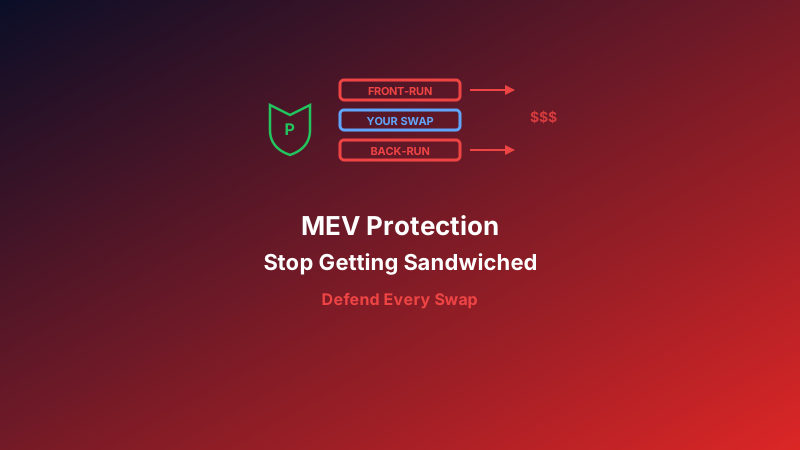
MEV refers to the profit that block producers and specialized bots can extract by manipulating the order of transactions within a block. They can insert their own transactions before yours (frontrunning), after yours (backrunning), or around yours (sandwiching).
The simplest analogy: imagine you are in line at a currency exchange. You want to buy euros. Someone sees your order, cuts in front of you to buy euros first (driving the price up slightly), then lets you buy at the higher price, and immediately sells their euros back at the price your purchase pushed it to. You got a slightly worse deal. They pocketed the difference. That is a sandwich attack.
How a Sandwich Attack Works: Step by Step
Let us walk through a concrete example.
You want to swap 10 ETH for a token called ABC on Uniswap. You submit the transaction with 1% slippage tolerance, meaning you will accept up to 1% less ABC than the quoted amount.
- Detection. A MEV bot monitors the mempool and sees your pending transaction. It calculates that your 10 ETH swap will move the ABC price by roughly 0.5%.
- Frontrun. The bot submits its own buy transaction for ABC before yours, with a higher gas fee to ensure it gets included first. This buy pushes the price of ABC up by, say, 0.3%.
- Your transaction. Your swap now executes at a price that is 0.3% worse than it would have been without the frontrun. You receive fewer ABC tokens. Since this is within your 1% slippage tolerance, the transaction still goes through.
- Backrun. Immediately after your transaction, the bot sells the ABC tokens it bought in step 2. Your large buy pushed the price up further, so the bot sells at a profit. The bot's sell pushes the price back down.
The net result: you received 0.3% fewer tokens. The bot pocketed the difference minus gas costs. The entire attack happened within a single block, taking less than 12 seconds on Ethereum.
How Much Does MEV Cost Users?
The scale of MEV extraction is staggering:
- Total MEV extracted on Ethereum since the Merge: over $600 million (per Flashbots data)
- Sandwich attacks specifically: the dominant form, accounting for roughly 50-60% of all MEV on Ethereum
- jaredfromsubway.eth, the most notorious sandwich bot, spent over $90 million in gas fees and still turned a $40+ million profit — giving you a sense of the margins involved
- Daily MEV on Ethereum in active markets: $1-5 million
- Solana MEV: harder to measure due to different architecture, but estimated at hundreds of millions annually through Jito-related extraction
Most individual users lose $1-$50 per swap to sandwich attacks, depending on trade size and liquidity conditions. Larger trades on thinner liquidity pairs get hit harder. If you trade actively — say, 10 swaps per week — you could easily be losing $100-$500 monthly to MEV without knowing it.
Protection by Chain
MEV mitigation looks different on every chain because each has a different transaction ordering mechanism.
Ethereum: Flashbots Protect and MEV Blocker
Flashbots Protect is the most established MEV protection tool for Ethereum. Instead of sending your transaction to the public mempool (where bots can see it), Flashbots Protect sends it directly to block builders through a private channel. Bots in the public mempool never see your transaction, so they cannot sandwich it.
How to use Flashbots Protect:
- Add the Flashbots Protect RPC to your wallet (MetaMask, Rabby, etc.)
- RPC URL:
https://rpc.flashbots.net - Chain ID: 1 (Ethereum mainnet)
- All transactions from that wallet now route through Flashbots
The tradeoff: transactions sent through Flashbots Protect may take slightly longer to be included in a block because they are only available to builders who participate in the Flashbots ecosystem (which is most, but not all). In practice, the delay is usually a few seconds at most.
MEV Blocker (by CoW Protocol) is an alternative that functions similarly. It sends transactions to a network of searchers who compete to give you the best execution. If your transaction generates any MEV, MEV Blocker attempts to return a portion of that value to you as a rebate.
RPC URL for MEV Blocker: https://rpc.mevblocker.io
Both are free to use. There is no reason not to have one of these configured as your default RPC for Ethereum.
Solana: Jito Tips and Priority Fees
Solana's transaction ordering works differently from Ethereum. There is no traditional mempool — transactions are forwarded directly to the current block leader. However, MEV still exists through Jito, a modified validator client that enables a block-space auction similar to Ethereum's MEV ecosystem.
On Solana, MEV protection is less about hiding your transaction and more about ensuring fast inclusion so bots have less time to react:
- Jito tips: Adding a tip through Jito's bundle system can get your transaction included faster and more predictably. Many Solana wallets and DEXs now support Jito tips natively.
- Priority fees: Setting an appropriate priority fee helps your transaction land in the block before bots can react. During high congestion, this is essential.
- Transaction simulation: Solana bots simulate transactions before they land. Using DEXs that minimize the window between simulation and execution helps reduce exposure.
Solana's MEV landscape is more opaque than Ethereum's, and protection options are less mature. The best defense on Solana is using DEXs with built-in protection (discussed below) and keeping slippage tight.
Layer 2s: Sequencer Advantage
On L2 rollups like Arbitrum, Optimism, and Base, the sequencer (typically operated by the L2 team) controls transaction ordering. This centralized ordering means that public mempool-based sandwich attacks are largely eliminated — there is no public mempool to spy on.
However, the sequencer itself could theoretically extract MEV (or allow preferred partners to do so). In practice, major L2 sequencers claim not to engage in harmful MEV, and the significantly lower gas costs on L2s mean that the profit margin for sandwich attacks is much smaller even when they occur.
L2s are inherently more MEV-resistant than Ethereum L1 for everyday users. If you are doing simple swaps, using an L2 avoids most MEV concerns while also saving on gas fees.
DEX-Level Protection
Beyond infrastructure-level protection, your choice of DEX matters enormously for MEV exposure.
CoW Swap (Ethereum, Gnosis Chain)
CoW Swap is purpose-built for MEV protection. Instead of executing your swap immediately on-chain, CoW Swap collects orders and tries to match them peer-to-peer (Coincidence of Wants, hence "CoW"). Trades that cannot be matched P2P are routed through an auction where solvers compete to give you the best price.
Because your order is never visible in the public mempool and execution happens through a competitive solver auction, sandwich attacks are essentially impossible on CoW Swap. It also supports gasless trading (you sign a message rather than a transaction, and the solver pays gas on your behalf).
CoW Swap is the single best tool for MEV protection on Ethereum if you are not in a rush to have your trade execute instantly.
1inch Fusion
1inch Fusion mode operates similarly to CoW Swap. Your order is filled by professional market makers (called resolvers) who compete to give you the best price. The order is not broadcast to the public mempool, eliminating sandwich attack exposure.
1inch Fusion supports Ethereum, BSC, Polygon, Arbitrum, Optimism, and other chains. It is a good option for multi-chain users who want MEV protection across multiple networks.
Limit Orders
On any DEX that supports limit orders (1inch, Uniswap, CoW Swap, Jupiter on Solana), using a limit order instead of a market swap eliminates sandwich attack risk entirely. A limit order executes at your specified price or better — there is no slippage tolerance for a bot to exploit.
The tradeoff is that limit orders may not fill immediately (or at all if the price does not reach your target). For non-urgent trades, this is the simplest MEV protection available.
Slippage Settings
If you are using a standard AMM DEX without MEV protection, your slippage tolerance directly determines how much a sandwich bot can extract from you. Lower slippage means less extraction but higher risk of transaction failure.
For liquid pairs (ETH/USDC, major tokens): set slippage to 0.5% or less.
For medium-liquidity tokens: 1-2%.
For low-liquidity memecoins: you may need 5-15%, but understand that higher slippage tolerance is an open invitation for sandwich bots. On these trades, the potential MEV extraction is a cost of doing business.
Advanced Protection Strategies
Private RPCs
Beyond Flashbots Protect and MEV Blocker, several private RPC services offer MEV protection with additional features:
- Merkle (by Flashbots): Enhanced version of Flashbots Protect with faster inclusion and MEV rebates
- BloxRoute: Offers private transaction routing with optimized inclusion speeds
- Alchemy Private Transactions: Integrates with Alchemy's infrastructure for reliable private transaction submission
These services are free or very low cost for individual users. The main consideration is trust — you are routing all your transactions through their infrastructure, so choose a reputable provider.
When MEV Protection Matters vs. Does Not
Not every transaction needs MEV protection. Here is a practical guide:
MEV protection is critical for:
- Large swaps (over $1,000 on Ethereum, over $500 on Solana)
- Swaps on low-liquidity pairs where price impact is high
- Any trade where you need to set high slippage tolerance
- Limit order executions on chains without native protection
MEV protection is less important for:
- Small swaps under $100 (the MEV profit is often less than the bot's gas costs)
- Transactions on L2s with centralized sequencers
- Token transfers (sends/receives) that do not interact with DEXs
- Trades on highly liquid pairs (ETH/USDC on Uniswap v3) where the price impact is negligible
MEV protection does not help with:
- Intentional arbitrage or trading strategies where you want to be fast
- NFT mints (different type of MEV, not sandwich-based)
- Smart contract interactions that do not involve token swaps
Checking If You Have Been Sandwiched
Several tools let you check your historical MEV exposure:
- EigenPhi (eigenphi.io): Comprehensive MEV analytics for Ethereum. Paste your transaction hash to see if it was sandwiched.
- Flashbots MEV Explorer: Shows MEV extracted from specific transactions.
- Jito Explorer (for Solana): Provides visibility into Solana MEV activity.
- Dune Analytics: Community dashboards tracking MEV extraction by protocol, bot, and method.
Checking your past transactions can be eye-opening. Many users discover they have been losing more to MEV than they realized, which motivates adopting protection tools.
The Future of MEV
MEV is not going away. It is a fundamental property of any system where transaction ordering has financial consequences. However, the tools for protecting users continue to improve:
- Encrypted mempools (being researched for Ethereum) would hide transaction details until they are included in a block, eliminating information advantage
- Order flow auctions (CoW Swap, MEV Blocker) return MEV profits to users rather than letting them accrue to bots
- Application-level protections are being built into more DEXs by default, so users do not need to know about MEV to be protected
The trend is clearly toward user protection becoming the default rather than an opt-in feature. But in 2026, you still need to take active steps to protect yourself.
Conclusion
MEV and sandwich attacks are a hidden tax on every DeFi user. The good news is that protection in 2026 is easier than ever: add Flashbots Protect or MEV Blocker as your Ethereum RPC (takes 30 seconds), use CoW Swap or 1inch Fusion for non-urgent trades, set tight slippage on liquid pairs, and consider L2s for smaller transactions.
The minimum viable protection is simply switching your Ethereum RPC to Flashbots Protect. That single change eliminates the vast majority of sandwich attacks for zero cost and near-zero friction. If you do nothing else after reading this guide, do that. Your future self will thank you for the hundreds of dollars saved over the coming year.
Tags
Ready to start trading?
Compare top cryptocurrency exchanges and find the best platform for you.
Compare Exchanges