
Berachain Proof-of-Liquidity Explained 2026: How PoL Actually Works
Berachain's Proof-of-Liquidity replaces proof-of-stake security with a liquidity-bribing flywheel. How BERA, BGT, and HONEY interact, why validators chase BGT delegations, and what could break the model.
WELC Team
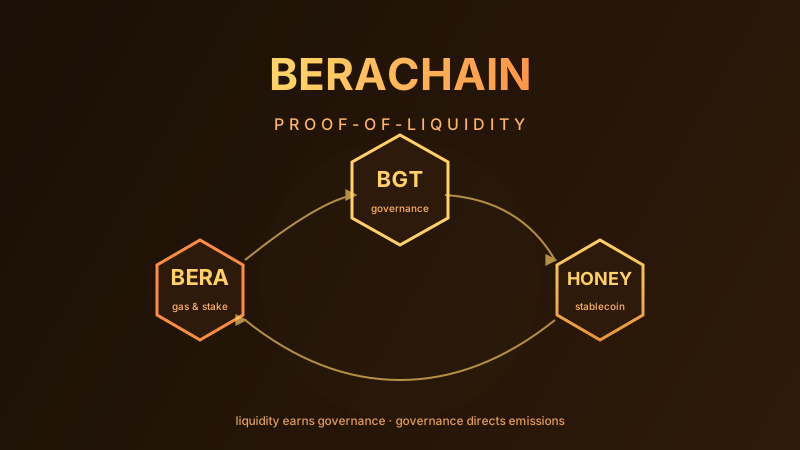
Every new L1 launches with a consensus mechanism and a story about why it's different. Most of those stories are marketing. Berachain is one of the few recent L1s where the consensus mechanism really is structurally different — and understanding it is the prerequisite for understanding whether the chain is a working economic system or an elaborate points loop.
Berachain uses Proof-of-Liquidity (PoL), a mechanism that separates the security token from the governance token and forces validators to compete for the attention of liquidity providers on the chain's own DeFi protocols. It is the first mainstream L1 to deliberately fuse consensus with DEX incentives as a single system.
This post explains how PoL actually works, how the three-token structure (BERA, BGT, HONEY) connects, where the incentive design could break, and what to look for as the chain matures past its initial incentive phase.
TL;DR
- Proof-of-Liquidity is a PoS variant where validator rewards are earned not by direct stake but by attracting delegations of a non-transferable governance token (BGT) that is itself earned by providing liquidity to approved DeFi protocols
- Three tokens: BERA (gas and base security stake), BGT (non-transferable governance, directs emissions), HONEY (overcollateralized stablecoin)
- The flywheel: LPs earn BGT by providing liquidity → delegate BGT to validators → validators with most BGT produce blocks and earn fees → validators bribe LPs to keep delegating
- This is a feature, not a bug — the chain deliberately monetizes the incentive market that every other L1 runs off-chain
- Structural risk: BGT emissions are the lifeblood of the system. When emissions taper, the flywheel either transitions to genuine fee capture or collapses into a ghost chain
- Watch in 2026: whether TVL retains after initial BERA unlocks, whether HONEY stays pegged through volatility, and whether validator revenue becomes meaningful without BGT inflation
Why PoL Exists — The Problem With Standard PoS
In a vanilla proof-of-stake chain like Ethereum, validators stake the native token and earn inflation plus transaction fees. The chain's security token is also its governance token is also its fee token. This works, but it has a side effect: once tokens are staked for security, they aren't productive capital for the chain's own DeFi economy.
Every PoS L1 fights the same battle: how do you get capital into the chain's DEXs, lending markets, and stablecoins while also securing the chain? Most answer with emissions — LP farming rewards paid in the native token. Those rewards are inflation, and inflation is paid out regardless of whether it improves security.
Berachain's insight: what if the inflation you'd pay as LP rewards was the security budget, issued as a separate token that can only be used by committing capital to the chain's DeFi?
That's PoL in one sentence. The rest is implementation details.
The Three Tokens
BERA
- The native gas token — every transaction on Berachain pays fees in BERA
- Also used as the base security stake — validators must lock BERA to register and operate
- Standard transferable ERC-20-like asset, tradable on exchanges
BERA behaves like most L1 natives. It's the thing you pay to use the network and the thing validators put at stake to participate.
BGT (Bera Governance Token)
- Non-transferable. You cannot sell BGT. You cannot swap it. You earn it or you don't have it
- Earned by providing liquidity to reward vaults — specific pools or protocols approved by governance
- Used to delegate voting power to validators — this is the core of PoL
- Can be burned 1:1 for BERA — the one-way exit from BGT to tradable BERA
The non-transferability is the whole trick. It means BGT has to be used in the system, not flipped on exchanges. If you want to realize BGT as cash, you must burn it for BERA, which removes your governance power in the process.
HONEY
- Overcollateralized stablecoin native to Berachain
- Backed by collateral assets (USDC, USDT, and other approved tokens)
- Mint/burn arbitrage keeps HONEY near $1
- Used as the primary stable liquidity leg in most Berachain DEX pools
HONEY's role is to be the chain's native stablecoin so that the DEX liquidity pairs that pay BGT rewards don't depend on bridged stablecoins controlled elsewhere.
How PoL Actually Works — The Full Flywheel
Follow a user through the system:
Step 1. Provide liquidity. A user deposits into an approved reward vault — for example, the BERA/HONEY pool on BEX (Berachain's native DEX). They receive LP tokens.
Step 2. Stake LP tokens in the reward vault. Instead of standard LP farming in the native token, reward vaults emit BGT to the stakers.
Step 3. Accumulate BGT. The user now has non-transferable BGT. Two options:
- Burn it for BERA (1:1) and exit the system
- Delegate it to a validator
Step 4. Delegate BGT to a validator. Delegating BGT to a validator increases that validator's weight — roughly, its share of block production and reward capture.
Step 5. Validator earns BERA fees plus the right to direct new BGT emissions. Here's the part that makes PoL a flywheel. Validators with more delegated BGT earn more transaction fees AND have more say in which reward vaults receive new BGT emissions from the protocol.
Step 6. Validators bribe delegators. Because delegation directly determines validator revenue, validators compete by offering bribes — payments in BERA, HONEY, or other tokens — to delegators who point BGT at them. This is not a bug hidden behind shrugs; it is the explicit design.
Step 7. Delegators optimize. Delegators shop their BGT to whichever validator offers the best bribe package, compounding back into more LP deposits, which earn more BGT, which earn more bribes.
The flywheel is: liquidity earns governance, governance earns fees and bribes, fees and bribes buy more liquidity.
Why This Is Clever (And Why It's Controversial)
What's clever: Every chain has an incentive market. Curve wars, Convex, Aura, Votium — all of those emerged as off-chain-ish infrastructure to bribe governance token holders into directing emissions. Berachain took that entire dynamic and made it the consensus mechanism.
The result is that validators don't need to invent go-to-market strategies for their delegation businesses — bribing is built into the protocol. LPs don't need to guess which governance wars to join — the yield is explicit. DeFi protocols that want liquidity on Berachain know exactly how to buy it: propose a reward vault, compete in governance for BGT emissions, and run transparent bribes.
What's controversial: The model is only as healthy as BGT emissions. When the protocol issues a lot of BGT, LPs are well-compensated, validators have juicy delegations, and the flywheel spins. When BGT emissions taper — as they inevitably will — the system must transition to real fee capture or unwind.
The bear case: PoL is an elaborate liquidity rental scheme dressed up as consensus. The moment emissions slow, mercenary capital leaves, and the chain is left with whatever organic volume it managed to accumulate during the boom.
The bull case: PoL is the first honest consensus design that admits DEX liquidity is part of security, makes the subsidy explicit, and aligns validators with the actual economic activity on the chain.
Both sides are right about specific things. The empirical answer arrives when emissions taper.
The Validator Competition
On standard PoS chains, validators compete on uptime, commission rates, and occasionally on branding. On Berachain, validators compete on all of that plus a full bribe marketplace.
A Berachain validator's business looks like this:
- Costs: Infrastructure, BERA stake, bribe budget
- Revenue: Block production fees, commission on BGT-directed emissions, plus whatever share of bribes the validator itself captures rather than passing to delegators
- Strategy: Run a good node, publish clear bribe terms, target specific delegator cohorts (whales, protocols with treasury positions, retail DeFi users)
The emergent result is that validator operators are functionally running small capital markets desks alongside their infrastructure. Some validators are literally DeFi protocols (Bera-native projects operating their own validator to capture their own governance). Others are specialist node operators who compete on pure cost efficiency.
This is either thrilling or concerning depending on whether you think decentralization is about geography or about economic alignment. Berachain explicitly chose the latter.
HONEY and the Stablecoin Leg
HONEY matters for a reason that's easy to miss: most BGT-earning pools are paired with HONEY. If HONEY depegs, the entire BGT incentive market becomes distorted — LPs holding HONEY/BERA or HONEY/ETH pools take impermanent loss from the stablecoin side itself, and the yield math collapses.
HONEY is overcollateralized, backed primarily by USDC with diversification toward other approved collateral. The peg mechanics are standard mint-redeem arbitrage: mint HONEY by depositing $1 of collateral, burn HONEY for $1 of collateral. This works well in normal conditions.
The risks are the same as every collateralized stablecoin:
- Collateral risk: USDC itself had a depeg scare in March 2023; HONEY inherits whatever risks USDC carries
- Oracle risk: HONEY relies on price feeds for its collateral valuation
- Governance risk: Which collateral is approved is a governance decision. Bad additions dilute safety; missing additions miss opportunities
Through 2025 and into 2026, HONEY has held peg through normal volatility. The real test — a sharp 20–30% market move combined with a collateral asset under stress — has not yet happened.
The Unlocks Problem
Berachain launched publicly in early 2025 after a long testnet phase and a well-publicized community distribution. Token unlocks are scheduled over multiple years, and the BERA unlock cliff timing is a central piece of 2026 chain analysis.
The simple framing:
- Emissions phase (now): BGT incentives are generous, TVL is attracted, validator bribes are rich, prices reflect speculative expansion
- Unlock phase (ongoing through 2026–2027): Team and investor BERA unlocks meet the market; selling pressure competes against organic demand
- Mature phase (target): BGT emissions taper, real transaction fees support validator revenue, the chain either retains meaningful activity or not
The question is whether enough genuine DeFi economic activity takes root during the incentive-rich phase to sustain validator economics once incentives taper. Other L1s have faced the same transition — Solana's post-2022 survival was essentially a version of this, and so was Avalanche's post-2021 trough.
What to Watch Through 2026
- TVL retention after BERA unlocks — the clearest signal of whether Berachain liquidity is structural or mercenary
- Validator revenue composition — as BGT emissions decline, does the share of validator income coming from real transaction fees rise? If yes, PoL is working. If no, the flywheel is unwinding
- HONEY stability during volatility — the first sharp market move during a stressed week will tell you whether the peg mechanics hold at scale
- Protocol diversity — healthy chains have many apps with independent users. Berachain needs DeFi, NFTs, games, or social apps that earn BGT by attracting real users, not just by farming incentives
- Bribe market maturation — whether secondary markets for bribe aggregation (a Berachain-native Convex equivalent) emerge and how concentrated they become
Berachain is the most architecturally interesting L1 launch of the last two years, and also the one where the incentive-driven narrative and the long-term structural thesis are hardest to separate. If you're allocating capital, understand the flywheel you're participating in. If you're building, understand that PoL changes what "liquidity mining" means at the protocol level.
The honest verdict in April 2026: the mechanism works on its own terms during the expansion phase. Whether it survives the contraction phase is the only question that matters, and it won't be answered for another 12–18 months.
For context on competing L1 designs, see our Modular Blockchains: Celestia Explained guide, or compare with Layer 2 Solutions for scaling alternatives.
Tags
Ready to start trading?
Compare top cryptocurrency exchanges and find the best platform for you.
Compare Exchanges