
Modular Blockchains Explained: How Celestia and Avail Are Redefining Scalability
Modular blockchains separate execution, consensus, and data availability into specialized layers. Learn how Celestia, Avail, and EigenDA are solving the scalability problem differently than monolithic chains.
WELC Team
Modular Blockchains Explained: How Celestia and Avail Are Redefining Scalability
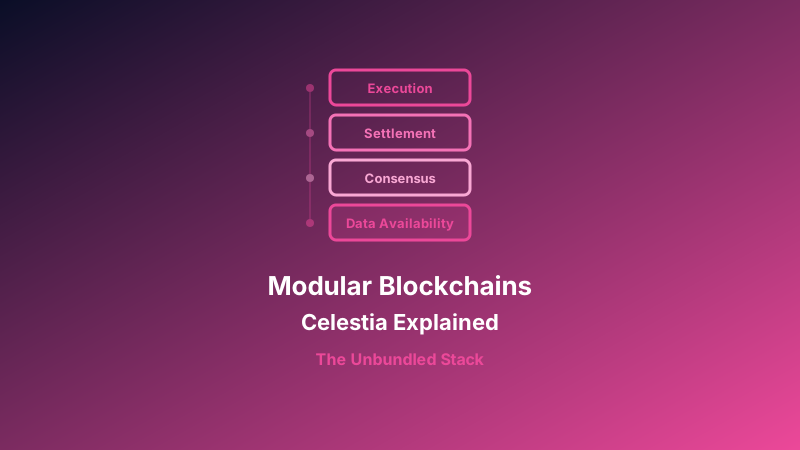
Every blockchain has to do four fundamental jobs: execute transactions, reach consensus on their order, ensure data availability so anyone can verify the chain, and handle settlement of final state. Traditional blockchains like Ethereum, Solana, and BNB Chain do all four jobs on a single chain. They are monolithic.
Modular blockchains take a radically different approach. Instead of one chain doing everything, they split these responsibilities across specialized layers — each optimized for its specific function. The result is dramatically better scalability without sacrificing security or decentralization.
This architectural shift is reshaping how blockchains are built, and understanding it is essential for anyone trying to make sense of the crypto infrastructure landscape in 2026.
The Monolithic Problem
Monolithic blockchains face an inherent trade-off known as the blockchain trilemma: you can optimize for any two of security, decentralization, and scalability, but not all three simultaneously.
Here is why:
- More throughput requires nodes to process more data, which means you need more powerful (and expensive) hardware
- More powerful hardware requirements mean fewer people can afford to run nodes
- Fewer nodes means less decentralization
- Less decentralization means weaker security guarantees
Ethereum chose security and decentralization at the cost of scalability — which is why gas fees spike during high demand. Solana chose scalability and security at the cost of decentralization — validators need powerful hardware, and the chain has experienced multiple outages.
Modular blockchains break this trade-off by letting each layer optimize independently.
The Four Layers of a Modular Stack
1. Execution Layer
This is where transactions actually run. Smart contracts execute, state changes are computed, and the new blockchain state is determined.
In a modular architecture, the execution layer is typically a rollup — a chain that processes transactions off the main chain and posts compressed results back. Examples include Arbitrum, Optimism, Base, zkSync, and Starknet.
Because execution is separated from other concerns, rollups can be optimized purely for speed and throughput. They do not need to worry about consensus or data availability — those are handled by other layers.
2. Consensus Layer
The consensus layer determines the canonical order of transactions and ensures all participants agree on the state of the chain. In a modular stack, Ethereum often serves as the consensus and settlement layer, providing the security guarantees that rollups inherit.
3. Data Availability (DA) Layer
This is where modular blockchains really innovate. The data availability layer ensures that all transaction data is published and accessible so that anyone can independently verify the chain's state.
Why is this important? If a rollup processes 10,000 transactions but never publishes the underlying data, nobody can verify that those transactions were processed correctly. The rollup operator could cheat, and nobody would know.
Traditionally, rollups post their data to Ethereum. This works but is expensive — data availability on Ethereum is the single largest cost for most rollups, even after EIP-4844 (proto-danksharding) reduced costs significantly.
Modular DA layers like Celestia, Avail, and EigenDA offer a cheaper alternative by building chains specifically optimized for data storage and availability.
4. Settlement Layer
The settlement layer is where disputes are resolved and final state is committed. For optimistic rollups, this includes the fraud proof mechanism. For ZK rollups, this is where validity proofs are verified. Ethereum typically serves as the settlement layer for most rollups.
The Major Modular DA Projects
Celestia
Celestia is the pioneering modular blockchain, launching its mainnet in October 2023. It is a purpose-built data availability layer that does one thing: makes data available.
How it works:
- Celestia uses a technique called Data Availability Sampling (DAS). Instead of requiring every node to download all data, nodes randomly sample small portions of blocks. If enough random samples succeed, the network can guarantee with high probability that the full data is available.
- This means Celestia nodes can verify data availability with minimal hardware — even a phone could theoretically run a light node.
- Celestia does not execute transactions or run smart contracts. It is purely a data publication layer.
Key stats:
- Block size: Up to 8 MB (compared to Ethereum's ~125 KB for blob data)
- Cost: Orders of magnitude cheaper than posting data to Ethereum
- Token: TIA (used for paying for blob data and staking)
- Light node participation: Thousands of light nodes running globally
Who uses it: Rollups that want cheaper data availability than Ethereum. Projects like Manta Pacific, Aevo, and numerous smaller rollups use Celestia for DA.
Avail
Avail (originally incubated within Polygon) is another dedicated DA layer with a focus on being a unification layer for the modular ecosystem.
Key differentiators:
- Avail DA: The data availability chain, using KZG polynomial commitments for data validity
- Avail Nexus: A coordination layer that enables cross-chain communication between rollups that use Avail
- Avail Fusion: A security mechanism that allows rollups to contribute to Avail's staking pool, creating shared security
Avail's vision is broader than just DA — it wants to be the connective tissue that links the fragmented rollup ecosystem together.
EigenDA
EigenDA takes a different approach by leveraging Ethereum's existing validator set through EigenLayer restaking.
Instead of building a new validator set from scratch, EigenDA pays Ethereum validators (via restaking rewards) to also store and attest to data availability. This means EigenDA inherits some of Ethereum's security guarantees from day one.
Advantages:
- No need to bootstrap a new validator set
- Security derived from Ethereum's massive staking pool
- Deeply integrated with the EigenLayer ecosystem
Trade-off: EigenDA's security is tied to EigenLayer's restaking model, which introduces additional smart contract risk and the complexity of the restaking ecosystem.
Modular vs Monolithic: A Comparison
| Aspect | Monolithic | Modular |
|---|---|---|
| Architecture | All functions on one chain | Specialized layers |
| Scalability | Limited by slowest function | Each layer scales independently |
| Cost | Higher (one chain does everything) | Lower (optimized per layer) |
| Complexity | Simpler to understand | More moving parts |
| Security | Single security model | Composed security (multiple layers) |
| Examples | Solana, BNB Chain | Ethereum + Celestia + Arbitrum |
Why This Matters for Users
If you are not a blockchain developer, you might wonder why any of this matters. The answer: cost and speed.
Every time you pay a gas fee on a rollup, a significant portion of that fee goes toward posting data to the DA layer. Cheaper DA means cheaper transactions for you. When rollups switched from posting data to Ethereum calldata to using Ethereum blobs (EIP-4844), transaction costs dropped by 90%+. Modular DA layers push this even further.
The modular approach also enables more experimentation. When launching a new blockchain is as simple as deploying a rollup that uses Celestia for DA and Ethereum for settlement, the barrier to creating application-specific chains drops dramatically. This is why we are seeing an explosion of new rollups — each optimized for their specific use case.
The Criticism
Modular architecture has vocal critics:
Complexity: More moving parts means more things that can go wrong. If the DA layer has an issue, every rollup that depends on it is affected. Monolithic chains have a simpler failure model.
Composability fragmentation: When every application runs on its own rollup, interacting between them becomes harder. Swapping tokens across rollups requires bridges, which are historically the most attacked component in crypto.
Security assumptions: Modular stacks inherit the security of their weakest layer. If a rollup uses Celestia for DA but Ethereum for settlement, its security depends on both chains functioning correctly.
Is it actually needed? Solana proponents argue that a well-engineered monolithic chain with hardware-optimized validators can achieve the same scalability without the complexity. Solana processes thousands of transactions per second at sub-cent costs — without needing a separate DA layer.
The Future of Modular Architecture
Despite the criticisms, the modular thesis is winning in terms of developer adoption. The number of rollups deployed has exploded, and most new blockchain projects are launching as rollups rather than standalone Layer 1s.
Key trends to watch:
- Rollup-as-a-Service (RaaS): Companies like Conduit, Caldera, and AltLayer make deploying a rollup as easy as spinning up a cloud server
- Cross-rollup communication: Projects like Avail Nexus, Espresso, and Hyperlane are building the infrastructure to make rollups feel like one unified network
- ZK compression: Zero-knowledge proofs are making it possible to verify computation without storing all the underlying data, potentially reducing DA requirements further
- Data availability committees: Hybrid approaches where a small committee of known parties attests to data availability, trading decentralization for cost savings
What Should You Know?
The monolithic vs modular debate is one of the most important architectural decisions in blockchain. Neither approach is definitively superior — they represent different trade-offs between simplicity, cost, decentralization, and performance.
As a crypto user, the modular stack affects you primarily through lower fees and more choices. The chain you use tomorrow might be a rollup you have never heard of, posting data to Celestia, settling on Ethereum, and you will not even know or care about the architecture underneath. You will just notice that your transaction cost a fraction of a cent and confirmed instantly.
And that is exactly the point. The best infrastructure is the kind you never have to think about.
Tags
Ready to start trading?
Compare top cryptocurrency exchanges and find the best platform for you.
Compare Exchanges