
Yield-Bearing Stablecoins Compared: sDAI vs. USDY vs. sUSD vs. YLDS (2026)
Compare yield-bearing stablecoins sDAI, USDY, sUSD, and YLDS — APY rates, risk profiles, chain availability, and how they differ from traditional stablecoin lending.
Last updated: April 8, 2026. APY rates change frequently — verify current rates on each protocol's official site before investing.
You're holding stablecoins. They're sitting idle. Somewhere between mattress-stuffing and gambling on leverage, there's a better option — stablecoins that automatically accumulate yield while you sleep.
Yield-bearing stablecoins have grown from a niche DeFi experiment to one of the fastest-growing categories in crypto. Combined market cap crossed $12 billion in early 2026, up from under $2 billion in 2024. The concept is simple: instead of holding a static 1:1 USD-pegged token, you hold a token that accrues value over time, backed by real yield from T-bills, lending markets, or staking rewards.
But not all yield-bearing stablecoins are the same. The four dominant players — sDAI, USDY, sUSD, and YLDS — have radically different yield sources, risk profiles, chain availability, and regulatory postures. This guide breaks them all down so you can make an informed choice.
TL;DR
- Yield-bearing stablecoins automatically accrue returns inside the token itself, eliminating the need to deposit into a lending protocol
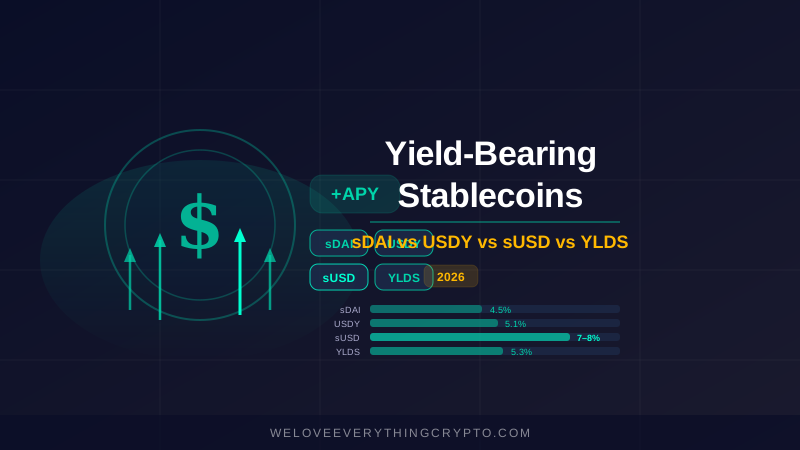
- sDAI (Sky/MakerDAO) is the OG, Ethereum-native, backed by the DAI Savings Rate — currently ~4.5% APY from on-chain lending and T-bill exposure
- USDY (Ondo Finance) is the RWA leader — backed 1:1 by short-term US Treasuries, yielding ~5.1% APY but restricted to accredited/non-US investors
- sUSD (Solayer) is the Solana native — built on restaking infrastructure, yielding ~7–8% APY with higher smart contract risk
- YLDS (Figure Markets) is the most regulated option — registered as a security with the SEC, paying ~5.3% APY, legally accessible to US retail investors
- The CLARITY Act (pending US legislation) could ban yield in US-accessible stablecoins, making regulatory risk the single most important factor to watch
What Makes Yield-Bearing Stablecoins Different
The Problem with Idle Stablecoins
Traditional stablecoins like USDC and USDT are static. Hold $10,000 USDC for a year and you still have $10,000 USDC. You earn nothing. To generate yield, you have to:
- Deposit into Aave, Compound, or another lending protocol
- Manually claim and re-deposit rewards
- Manage liquidation risk if you're borrowing against collateral
- Pay gas fees every time you interact
This creates friction. Most retail holders never bother.
How Yield-Bearing Stablecoins Solve This
Yield-bearing stablecoins embed the return mechanism inside the token itself. There are two main design patterns:
Rebasing tokens — The token quantity increases over time. If you hold 1,000 tokens, after a year at 5% APY you might hold 1,050 tokens, still each worth $1.
Appreciating price tokens — The token price rises above $1 while the quantity stays fixed. Hold 1,000 tokens at $1.00; after a year at 5% APY each token is worth $1.05, so you hold $1,050 in value.
Most modern yield-bearing stablecoins use the appreciating price model (often called "ERC-4626 vault tokens" on Ethereum) because it's simpler to integrate with DeFi protocols.
Yield-Bearing vs. Lending Protocols
| Feature | Yield-Bearing Stablecoin | Lending Protocol (e.g. Aave) |
|---|---|---|
| Yield accrual | Automatic, in-wallet | Must deposit into protocol |
| Custody | Self-custodied (usually) | Locked in smart contract |
| DeFi composability | Use as collateral elsewhere | Limited once deposited |
| Gas overhead | Mint once, hold | Multiple transactions |
| Yield source transparency | Fixed, disclosed | Variable, protocol-dependent |
The key advantage: you can use a yield-bearing stablecoin as collateral in a separate DeFi protocol while still earning its native yield. That's capital efficiency that traditional lending can't match.
The Four Contenders
sDAI — The MakerDAO/Sky OG
Overview
sDAI (Savings DAI) is the yield-bearing version of DAI, issued through the Sky Protocol (rebranded MakerDAO). When you deposit DAI into the DAI Savings Rate (DSR) contract, you receive sDAI. The peg is maintained by Sky's Peg Stability Modules, and yield flows from the protocol's revenue — a mix of on-chain lending interest collected by Maker vaults and, increasingly, real-world assets including tokenized T-bills.
How Yield Is Generated
Sky Protocol generates revenue through:
- Stability fees charged to CDP (collateralized debt position) vault users borrowing DAI
- RWA exposure — Sky holds a significant portion of collateral in tokenized US Treasuries via custodians like Centrifuge and Monetalis
- Spark Protocol — the native lending layer that captures additional margin
The protocol governance sets the DSR rate. As of Q1 2026, the DSR sits at approximately 4.5% APY, having floated between 3.5% and 8% over the past 18 months depending on Maker's collateral mix and broader rate environment.
Key Details
- Token standard: ERC-4626 (appreciating price)
- Chains: Ethereum mainnet, with bridged versions on Gnosis Chain, Base, and Arbitrum
- Minimum investment: None
- Custody: Non-custodial smart contract
- Regulatory status: Unregistered DeFi protocol — operates under CFTC/SEC gray area
- Available to US investors: Yes (no KYC)
Strengths
- Battle-tested: DSR has operated without incident since 2019
- Deepest liquidity of any yield-bearing stablecoin (~$3.1B TVL)
- No KYC or geographic restrictions
- sDAI accepted as collateral on Spark, Morpho, and Aave v3
Weaknesses
- Yield fluctuates with governance votes — can drop to near-zero if Sky deprioritizes DSR
- Multi-layer smart contract risk (Sky Protocol + individual vault contracts)
- DAI itself relies on overcollateralized crypto + centralized RWA — complex depeg scenarios exist
USDY — Ondo Finance's T-Bill Token
Overview
USDY (US Dollar Yield token) is Ondo Finance's flagship yield-bearing stablecoin, backed directly by short-duration US Treasury bills held in a bankruptcy-remote SPV (Special Purpose Vehicle). Ondo is one of the leading RWA (Real World Asset) protocols, and USDY represents the cleanest implementation of "put T-bills on-chain."
How Yield Is Generated
USDY's yield mechanism is about as straightforward as it gets in DeFi:
- Users deposit USD (or USDC) to Ondo
- Ondo buys short-term US Treasury bills through regulated broker-dealers
- Treasury coupon payments accrue back into the USDY price
- The token appreciates at roughly the 90-day T-bill rate
As of April 2026, USDY yields approximately 5.1% APY, directly tracking the Federal Funds Rate with a small operational spread taken by Ondo.
Key Details
- Token standard: Appreciating price (USDY price starts at $1.00 and rises)
- Chains: Ethereum, Solana, Arbitrum, Mantle, Sui, Aptos, Cosmos (Neutron)
- Minimum investment: $500 (institutional tiers available)
- Custody: Custodial — assets held by regulated third parties (Clear Street)
- Regulatory status: Exempt security (Reg S / Reg D) — not registered with SEC
- Available to US investors: No — restricted to non-US and accredited investors only
Strengths
- Highest transparency of any option — on-chain attestations updated daily
- Backed by US Treasuries — essentially zero credit risk in the underlying
- Widest chain availability: 7+ networks as of 2026
- Ondo raised $110M+ from Founders Fund, Pantera, and Coinbase Ventures
Weaknesses
- US retail investors are explicitly excluded — major competitive disadvantage
- KYC required for all users — not permissionless
- Custody risk: if Ondo or Clear Street fails, redemption process is complex
- Yield tied to Fed rate — falls when rates fall
sUSD — Solayer's Restaking Stablecoin
Overview
sUSD is the newest and most experimental of the four. Issued by Solayer, a Solana restaking protocol, sUSD generates yield not from T-bills or lending, but from Solana network fees and MEV (Maximal Extractable Value) captured through its restaking infrastructure.
The thesis: as Solana processes more transactions, the fees and MEV generated by validators increase. Solayer's restaking layer routes a share of this economic activity to sUSD holders, creating a yield that's theoretically uncorrelated with interest rates.
How Yield Is Generated
- Users mint sUSD by depositing USDC
- USDC is used to acquire sSOL (Solayer's restaked SOL)
- Validator fees, priority fees, and MEV rewards flow back to sUSD holders
- The yield is Solana-native — driven by network activity, not external rates
Current yield: approximately 7–8% APY as of Q1 2026, though this figure is volatile and has ranged from 5% to 12% depending on Solana network congestion.
Key Details
- Token standard: Solana SPL token (appreciating price)
- Chains: Solana only
- Minimum investment: None
- Custody: Non-custodial (Solana program)
- Regulatory status: Unregistered DeFi protocol
- Available to US investors: Yes (no KYC)
Strengths
- Highest current yield of the four options
- Non-correlated yield source (network activity, not interest rates)
- No KYC, permissionless minting
- Fast settlement on Solana (~400ms finality)
Weaknesses
- Newest and least battle-tested protocol — Solayer launched in late 2024
- Smart contract risk is highest of the four options
- Solana restaking is a nascent concept with unproven failure modes
- Yield can compress significantly during Solana bear markets or low-activity periods
- sUSD not widely accepted as DeFi collateral yet
YLDS — Figure Markets' Regulated Yield Coin
Overview
YLDS (pronounced "yields") is the most unusual entry on this list: it's a yield-bearing stablecoin that's registered as a security with the US SEC, issued by Figure Markets. This registration means YLDS can be legally offered to US retail investors, paying them yield directly — something that most other yield-bearing stablecoins technically cannot do for US residents under current securities law.
Figure Markets is a blockchain-native financial platform founded by Mike Cagney (SoFi founder). The company has built its own blockchain (Provenance Blockchain) and YLDS is natively issued there.
How Yield Is Generated
- YLDS is backed by a portfolio of cash-equivalent instruments: primarily overnight repo agreements, money market funds, and short-duration Treasuries
- Figure uses a bank-grade custodial structure — assets held at regulated US banks
- Yield is paid monthly as a cash dividend (not through token appreciation) — a unique structural choice
- Current yield: approximately 5.3% APY as of April 2026
Key Details
- Token standard: ERC-20 on Provenance Blockchain (bridgeable)
- Chains: Provenance Blockchain primarily; Ethereum bridge available
- Minimum investment: $1 (but KYC required)
- Custody: Custodial — regulated US banks
- Regulatory status: Registered security (SEC Form S-1 approved)
- Available to US investors: Yes — the only SEC-registered option
Strengths
- Only yield-bearing stablecoin fully legal for US retail investors
- Highest regulatory certainty — SEC registration provides clear legal protection
- Monthly yield payments in cash — familiar to traditional finance users
- Figure's banking connections mean strong redemption guarantees
Weaknesses
- KYC/AML required — not permissionless
- Lower DeFi composability — Provenance Blockchain has limited DeFi ecosystem
- Being a registered security means more compliance overhead and slower innovation
- Lower yield than sUSD; comparable to USDY but with more friction
The Big Comparison Table
| sDAI | USDY | sUSD | YLDS | |
|---|---|---|---|---|
| Issuer | Sky Protocol | Ondo Finance | Solayer | Figure Markets |
| APY (Apr 2026) | ~4.5% | ~5.1% | ~7–8% | ~5.3% |
| Yield Source | DSR (lending + RWA) | US T-Bills | Solana restaking | Repos + T-Bills |
| Backing | Multi-collateral DAI | US Treasuries | USDC → restaked SOL | Cash + Repos |
| Chains | ETH, Base, Arbitrum, Gnosis | ETH, SOL, ARB, Mantle, Sui, Aptos | Solana only | Provenance + ETH bridge |
| KYC Required | No | Yes | No | Yes |
| US Retail Access | Yes (gray area) | No | Yes (gray area) | Yes (registered) |
| Minimum | None | $500 | None | $1 |
| Custody | Non-custodial | Custodial | Non-custodial | Custodial |
| Regulatory Status | Unregistered DeFi | Exempt security | Unregistered DeFi | SEC-registered security |
| Smart Contract Risk | Medium | Low | High | Low |
| Depeg Risk | Low–Medium | Very Low | Medium | Very Low |
| TVL / AUM | ~$3.1B | ~$800M | ~$180M | ~$150M |
| DeFi Composability | Excellent | Good | Limited | Poor |
Risk Analysis
Smart Contract Risk
Every yield-bearing stablecoin has smart contract exposure. The risk spectrum:
- sDAI: Sky Protocol has been audited dozens of times and operated since 2017. The DSR contract is one of the most reviewed in DeFi. However, the complexity of the full Sky system (vaults, PSMs, RWA modules) creates surface area for edge-case exploits.
- USDY: The on-chain component is minimal — mostly a token contract tracking off-chain T-bill NAV. Smart contract risk is low.
- sUSD: Solayer is less than 18 months old. Restaking mechanisms are inherently complex, and an exploit in the validator delegation layer could affect sUSD holders. Highest smart contract risk of the four.
- YLDS: On-chain complexity is minimal (basic ERC-20). Primary risk is Figure Markets as a company, not the contract itself.
Depeg Risk
What happens if the token breaks its $1 peg?
- sDAI: DAI itself has depegged briefly in past market crises (March 2020, FTX collapse). sDAI is only as stable as DAI. However, Sky's $9B+ in diversified collateral provides strong backstop.
- USDY: Near-zero depeg risk assuming US Treasuries don't default. The SPV structure provides legal bankruptcy protection from Ondo itself.
- sUSD: Higher depeg risk if the underlying restaking economics collapse or if a large liquidation cascade hits Solana. Novel mechanism = novel failure modes.
- YLDS: Backed by regulated bank-held cash instruments. Depeg risk is essentially sovereign/bank-failure risk.
The CLARITY Act Risk — The Elephant in the Room
The most significant risk across all yield-bearing stablecoins is regulatory. The US CLARITY Act, advancing through Congress in early 2026, contains provisions that would:
- Classify stablecoins paying yield to holders as unregistered securities
- Require stablecoin issuers to obtain banking licenses
- Potentially ban yield-bearing stablecoins from being marketed to US retail investors
If passed in its current form, this would effectively ban sDAI, USDY, and sUSD from the US market, while YLDS (already SEC-registered) would likely be grandfathered or treated more favorably.
The irony: the most "DeFi" and permissionless options (sDAI, sUSD) carry the highest regulatory risk in the US. YLDS's compliance overhead starts to look like a competitive advantage.
Real Example: $10,000 Invested for 1 Year
Let's run through a concrete scenario. You deploy $10,000 into each option on April 8, 2026, and come back exactly one year later.
Assumptions:
- APY rates stay constant (they won't, but it simplifies comparison)
- No gas costs included
- You reinvest yield quarterly where applicable
| Option | Starting Value | Year-End Value | Gross Profit | Notes |
|---|---|---|---|---|
| sDAI | $10,000 | $10,450 | +$450 | DSR at 4.5%, auto-compounding |
| USDY | $10,000 | $10,510 | +$510 | 5.1% T-bill rate, token appreciates |
| sUSD | $10,000 | $10,750 | +$750 | 7.5% midpoint estimate, volatile |
| YLDS | $10,000 | $10,530 | +$530 | 5.3%, paid monthly as cash |
Additional considerations:
- sDAI winner scenario: Fed cuts rates aggressively. T-bill yields drop to 2%. sDAI DSR, backed partly by variable-rate lending, holds at 3.5%. sDAI outperforms T-bill-backed options.
- sUSD winner scenario: Solana network activity surges (e.g., new app chain migrations). MEV and fees spike. sUSD hits 12%+ APY for 6 months.
- YLDS winner scenario: CLARITY Act passes. sDAI and USDY exit US market. YLDS has no competition for compliant US yield products.
- sUSD worst case: Restaking exploit drains Solayer. sUSD price drops significantly. Highest potential loss of the four.
The expected value case: sUSD wins on raw yield, YLDS wins on regulatory safety, USDY wins on T-bill purity, sDAI wins on DeFi composability.
Who Should Use Which: Decision Framework
Use sDAI if:
- You're primarily on Ethereum and want the deepest DeFi integration
- You want to use your yield-bearing position as collateral elsewhere (Spark, Morpho)
- You're not a US resident worried about regulatory status
- You prefer battle-tested protocols over maximum yield
Use USDY if:
- You're a non-US investor or accredited US investor who has completed KYC
- You want maximum transparency on what's backing your yield (actual T-bills)
- You need multi-chain deployment across Solana, Arbitrum, Sui, etc.
- You're building a DeFi protocol that needs a credible RWA yield token as a building block
Use sUSD if:
- You're primarily on Solana and want native yield
- You have higher risk tolerance and want exposure to Solana network growth
- You're comfortable with a newer protocol and higher smart contract risk
- The additional 2–3% APY over alternatives is meaningful at your scale
Use YLDS if:
- You're a US retail investor who wants the cleanest legal standing
- You're a financial institution or RIA building regulated crypto products
- You prefer a familiar "dividend" payment structure over token appreciation
- You want to minimize regulatory risk above all else
The Bigger Picture
Yield-bearing stablecoins represent the clearest convergence of TradFi and DeFi. They're essentially money market funds on-chain — but with programmability, global access (in theory), and composability that no legacy money market fund can match.
The category is still early. Combined AUM of ~$12B is a rounding error compared to the $7 trillion global money market fund industry. But the growth trajectory is steep:
- 2023: $500M combined AUM
- 2024: $2.1B combined AUM
- 2025: $7.8B combined AUM
- 2026 Q1: $12B+ combined AUM
The regulatory headwinds are real and the CLARITY Act uncertainty is significant. But institutional demand for programmable yield-bearing dollar instruments is equally real — and it's growing faster than the legislation can keep up with.
Sources
- Sky Protocol Documentation — DAI Savings Rate — official DSR mechanism documentation
- Ondo Finance — USDY Product Page — USDY structure, eligibility, and T-bill backing details
- Solayer Documentation — sUSD — sUSD mechanism and restaking infrastructure
- Figure Markets — YLDS — SEC-registered yield coin product page
- RWA.xyz — Yield-Bearing Stablecoin Market Tracker — live AUM and APY tracking
- DeFiLlama — Stablecoin TVL Dashboard — on-chain TVL data
- US Congress — CLARITY Act Text — stablecoin regulatory framework bill
- Moody's — Tokenized Money Market Report 2025 — institutional analysis of RWA stablecoins
What's Next?
Disclaimer: This guide is for educational purposes only and should not be considered financial advice. Cryptocurrency investments carry significant risk. Always do your own research before making investment decisions.