
Liquid Staking and Restaking Explained: Earn Yield Without Locking Up Your Crypto
Learn how liquid staking with Lido stETH and Rocket Pool works, what restaking via EigenLayer means, and how to earn additional yield through restaking — plus the real risks involved.
Prerequisites
- Basic DeFi understanding
- How Ethereum proof-of-stake works
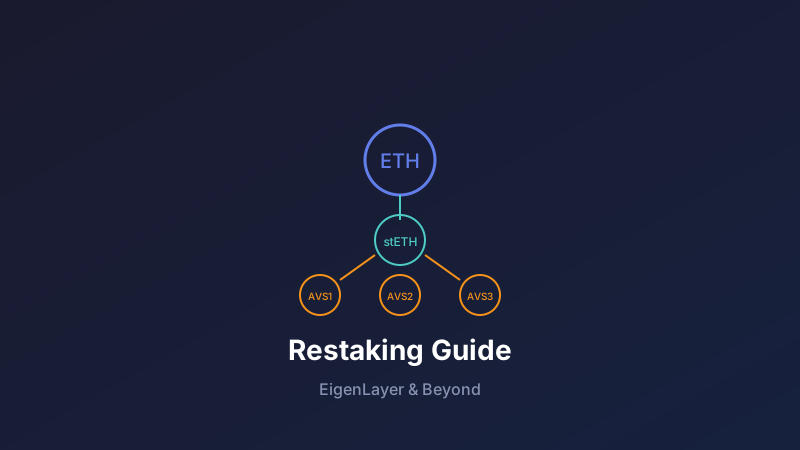
Staking Ethereum earns yield, but it used to mean locking your ETH away with no access until you decided to exit — a process that could take days or even weeks during congested exit queues. Liquid staking solved that problem by letting you stake ETH and receive a liquid token in return, one you can use anywhere in DeFi while your underlying stake continues earning rewards. Restaking then pushed the concept further: what if you could use that same staked ETH to secure additional networks and earn additional yield on top? That's the premise behind EigenLayer and the restaking ecosystem that has grown up around it.
TL;DR
- Liquid staking lets you stake ETH (or other PoS assets) and receive a liquid token (LST) representing your staked position
- Key LSTs: Lido's stETH (~3.8% APY), Rocket Pool's rETH (~3.5%), Binance's BETH
- LSTs are usable in DeFi — as collateral, in AMM pools, in yield strategies — while underlying stake earns rewards
- Restaking (via EigenLayer) lets you use staked ETH or LSTs to secure additional "Actively Validated Services" (AVS) for extra yield
- Restaking risks compound: slashing from multiple sources, smart contract exposure across multiple protocols, and liquidity risk
- The liquid restaking token (LRT) ecosystem (ether.fi, Puffer Finance, Kelp DAO) adds another abstraction layer on top
What Is Liquid Staking?
When Ethereum transitioned to proof-of-stake with The Merge in September 2022, validators were required to lock 32 ETH as a stake to participate in block production. Individual stakers who didn't have 32 ETH — or didn't want to run their own validator — needed another path to earn staking yield.
Liquid staking protocols solved this by pooling ETH from many users, running validators on their behalf, and issuing a token representing each user's share of the pool. That token — the liquid staking token, or LST — tracks the value of the underlying staked ETH plus accumulated rewards. You can sell it, lend it, use it as collateral, or deposit it into yield protocols while your ETH keeps earning staking rewards in the background.
This is the fundamental difference from native staking: with native staking, your ETH is locked. With liquid staking, you have a liquid, tradable claim on your staked ETH.
How Liquid Staking Works: The Mechanics
Here's the basic flow for Lido, the largest liquid staking protocol:
- You deposit ETH into Lido's smart contracts
- Lido pools your ETH with other depositors and deploys it to a set of whitelisted node operators who run Ethereum validators
- You receive stETH (staked ETH) at a 1:1 ratio to the ETH you deposited
- As validators earn staking rewards, the protocol rebases — meaning the number of stETH in your wallet automatically increases each day to reflect earned rewards
- When you want to exit, you can either swap stETH for ETH on a DEX (using pools like Curve's stETH/ETH pool) or submit a withdrawal request to the protocol, which exits validators and returns ETH (subject to a waiting period tied to the Ethereum exit queue)
Rocket Pool works differently in an important way: it uses a decentralized set of node operators, each of whom must put up a minimum bond (currently 8 ETH + RPL collateral) to run a minipool. This makes Rocket Pool more decentralized but also means its capacity to scale is more constrained. rETH is a non-rebasing token — instead of your balance increasing, the exchange rate between rETH and ETH increases over time as rewards accrue.
The Major Liquid Staking Protocols
Lido Finance (stETH): The dominant player with over $30B in staked ETH as of early 2026, representing roughly 30% of all staked ETH. stETH is the most liquid and most widely integrated LST in DeFi — it's accepted as collateral on Aave, Compound, Morpho, and MakerDAO, and it trades in massive Curve pools. The concentration risk (one protocol holding 30% of staked ETH) is a genuine concern for Ethereum's decentralization. Lido's DAO has implemented dual governance to give stETH holders veto power over certain protocol changes.
Rocket Pool (rETH): The decentralization-focused alternative, with a permissionless node operator set. rETH has around $4B TVL. Its governance token RPL must be staked by node operators, creating an additional layer of economic alignment. rETH trades at a slight premium to ETH in terms of exchange rate because it accumulates value rather than rebasing.
Binance BETH: Binance's centralized liquid staking product for ETH staked on the exchange. BETH is widely held (especially in Asia) but is fully custodial — Binance controls the validators and the redemption process. Not suitable for users who prioritize self-custody.
Frax Ether (sfrxETH): Frax's liquid staking product uses a two-token model — frxETH pegged to ETH, and sfrxETH which accrues all staking yield. Because not all frxETH is staked, sfrxETH earns a higher effective yield than single-token LSTs (often 4-5% APY). The trade-off is exposure to Frax's governance and stability mechanisms.
StakeWise V3: A modular liquid staking platform that allows individual operators to create their own staking vaults with custom parameters. osETH is the protocol's liquid staking token.
Using LSTs in DeFi
The "liquid" in liquid staking is what makes it powerful. Once you hold stETH or rETH, you have several options that vanilla staking doesn't offer:
Lending collateral: Deposit stETH on Aave v3 and borrow stablecoins against it. You earn staking yield on your stETH while using the borrowed stablecoins elsewhere. Your effective borrowing cost is the borrow APR minus the staking yield — and when borrow rates are low, you can effectively borrow cheaply while maintaining ETH exposure.
AMM liquidity provision: The Curve stETH/ETH pool is one of the most liquid pools in DeFi. Providing liquidity earns trading fees plus CRV rewards on top of the underlying staking yield. The risk is low relative to volatile token pairs because both assets trend toward parity.
Yield strategies: Protocols like Yearn Finance, Convex, and Pendle Finance build automated strategies around LSTs. Pendle, in particular, lets you split an LST into its principal component and its yield component — you can sell the yield upfront for a fixed return, or buy yield exposure for leveraged positions.
For a deeper look at how these yield strategies interact with risk, our yield farming risk assessment guide covers the framework in detail.
What Is Restaking?
Restaking is the concept of using already-staked ETH (or LSTs) as cryptoeconomic security for additional networks and services beyond Ethereum itself.
EigenLayer, launched in 2023 and grown to over $15B in restaked ETH by 2025, is the primary restaking protocol. The core insight: Ethereum's validator set has accumulated enormous economic security (hundreds of billions in staked ETH). New protocols that need economic security — oracle networks, bridges, data availability layers, sequencers — normally have to bootstrap their own token staking from scratch. EigenLayer lets these protocols "rent" Ethereum's security instead.
Actively Validated Services (AVS) are the services that use restaked security. Examples include:
- EigenDA: EigenLayer's own data availability layer (used by L2s as a cheaper alternative to posting data directly to Ethereum)
- Omni Network: A cross-chain messaging protocol secured by restaked ETH
- Lagrange: A ZK coprocessor for off-chain computation
- AltLayer: A restaked rollup framework
When you restake, you're opting your staked ETH into one or more AVSs. If those AVSs have slashing conditions (punishments for misbehavior), your restaked ETH is subject to those conditions on top of Ethereum's base slashing conditions.
Liquid Restaking Tokens (LRTs)
Managing restaking positions — choosing which AVSs to opt into, monitoring slashing risk, handling rewards — is complex. Liquid restaking protocols abstract this away, similar to how liquid staking abstracting native staking.
The major liquid restaking protocols:
ether.fi (eETH/weETH): The largest LRT protocol with over $6B TVL by early 2026. Users deposit ETH, receive eETH (or wrapped eETH — weETH), and ether.fi manages the restaking allocation across AVSs. ether.fi also runs its own validator infrastructure.
Puffer Finance: Focuses on enabling smaller node operators to participate in restaking. Uses anti-slashing technology to reduce risk for validators.
Kelp DAO (rsETH): Accepts multiple LSTs (stETH, ETHx, sfrxETH) and restakes them via EigenLayer, issuing rsETH as the unified liquid token.
Renzo Protocol (ezETH): Another multi-asset restaking protocol that aggregates exposure across EigenLayer AVSs.
Yield Comparison: Vanilla Staking vs Liquid Staking vs Restaking
| Strategy | Approximate APY | Liquidity | Complexity | Key Risks |
|---|---|---|---|---|
| Native ETH staking (solo) | 3.5–4% | None (queued withdrawals) | High (32 ETH, own node) | Slashing if validator misconfigured |
| Native ETH staking (pool) | 3.5–4% | None (queued withdrawals) | Low | Staking pool counterparty |
| Liquid staking (stETH) | 3.5–4% | High (DEX liquid) | Low | Smart contract, LST depeg |
| LST in DeFi (lending/LP) | 5–9% (strategy-dependent) | Medium | Medium | Protocol risk, liquidation |
| Restaking via EigenLayer | 4–6% (base + AVS rewards) | Low–Medium | Medium | Amplified slashing, smart contract |
| LRT (ether.fi weETH) | 5–8% | Medium | Low | LRT depeg, AVS slashing, layered contracts |
| LRT in DeFi | 8–14%+ | Low | High | All of the above, compounded |
APY figures reflect Q1 2026 conditions and will vary significantly with market conditions and AVS participation rates.
Risks of Liquid Staking and Restaking
Understanding risks is essential before committing capital. For more on evaluating DeFi risk systematically, see our advanced DeFi flash loan strategies guide which covers risk layering in depth.
LST depeg risk: stETH and other LSTs are supposed to trade at or near the value of ETH, but under stress conditions they can depeg significantly. During the 2022 bear market, stETH traded as low as 0.94 ETH as forced selling from leveraged positions overwhelmed DEX liquidity. If you need to exit quickly during a market panic, you may receive less ETH than your staking position is worth.
Smart contract risk: Every protocol in the stack — the liquid staking protocol, the restaking protocol, the LRT protocol, and any DeFi protocol you use on top — has smart contract code that could have bugs. Audits reduce but don't eliminate this risk. A vulnerability in Lido's withdrawal contracts, for example, would affect over $30B in staked ETH.
Slashing amplification: This is the most unique risk in restaking. Under normal Ethereum staking, your ETH can be slashed for double-signing or surround voting — behaviors that require deliberate misbehavior or serious validator misconfiguration. AVS slashing conditions may be different and potentially more easily triggered. If you're restaked across five AVSs and one has a bug that triggers mass slashing, your ETH is at risk even if you personally did nothing wrong.
Centralization risk: Lido's market share (approaching 30% of all staked ETH) is a systemic risk for Ethereum itself. If Lido's governance were compromised or its node operators colluded, they could theoretically threaten Ethereum's consensus. This is one reason the Ethereum community periodically debates whether to implement caps on liquid staking protocol market share.
Governance and upgrade risk: LRT and LST protocols are governed by DAOs and retain upgrade keys. A malicious or compromised governance vote could change parameters or redirect funds. Time-lock mechanisms and multisigs provide some protection, but they're not foolproof.
Liquidity risk for redemptions: During periods of high redemption demand, LRT tokens can depeg from their underlying value because the secondary market liquidity is insufficient. weETH has traded at discounts of 1-3% to its underlying value during volatile periods.
How to Get Started: A Practical Path
Step 1 — Native Ethereum staking yield: If you want the simplest possible approach, deposit ETH to Lido at stake.lido.fi and receive stETH. Hold it passively for staking yield. This is the lowest-risk entry point.
Step 2 — DeFi integration: Once comfortable holding stETH, consider depositing it to Aave as collateral and borrowing stablecoins, or providing stETH/ETH liquidity on Curve. The Aave strategy is well-understood and widely used.
Step 3 — Restaking exposure: If you want restaking exposure with abstracted complexity, depositing ETH into ether.fi is the most battle-tested option. ether.fi's long track record, multiple audits, and massive TVL make it one of the more trustworthy LRT protocols.
Step 4 — Advanced strategies: Using LRTs as collateral in lending protocols, or participating in Pendle markets on LSTs/LRTs for fixed yield or yield trading, are more complex strategies suited to experienced DeFi users.
For a comprehensive look at staking platforms across multiple chains, see our best crypto staking platforms guide.
The Road Ahead: EigenLayer Maturity and Beyond
EigenLayer has gone through significant growing pains. Its token (EIGEN) launched in 2024 with controversy around vesting cliffs and distribution. Full slashing was enabled gradually to avoid destabilizing the protocol. By early 2026, the ecosystem of AVSs is maturing — EigenDA has live mainnet usage from several L2s, and economic security in the restaking ecosystem is beginning to function more like its designers intended.
The broader restaking landscape is also expanding beyond Ethereum. Babylon Protocol brings Bitcoin restaking to the ecosystem, letting BTC holders use their Bitcoin as security for PoS chains. Symbiotic is building a competing restaking infrastructure designed to be multi-asset from the ground up.
Liquid staking and restaking represent a genuine evolution in how cryptoeconomic security is allocated and monetized. The yields are real, but so are the risks — and understanding both is essential before deploying capital in this space.
Sources
- Lido Finance protocol documentation and governance forum
- EigenLayer whitepaper and developer documentation
- ether.fi protocol reports and security audit disclosures
- Rocket Pool documentation and node operator statistics
- DefiLlama LST and LRT tracker data, Q1 2026
- Ethereum Foundation staking documentation
- Pendle Finance documentation on LST yield markets
- Dune Analytics: Ethereum staking dashboard
- Chainalysis DeFi Report 2025
What's Next?
Disclaimer: This guide is for educational purposes only and should not be considered financial advice. Cryptocurrency investments carry significant risk. Always do your own research before making investment decisions.