
VeChain EU Digital Product Passport: How Blockchain Meets the 2027 Compliance Deadline
VeChain is building production-scale EU Digital Product Passport infrastructure with Rekord and AMRC. Here's what the mandate means, which industries it hits first, and how blockchain solves it.
blockchain-architect
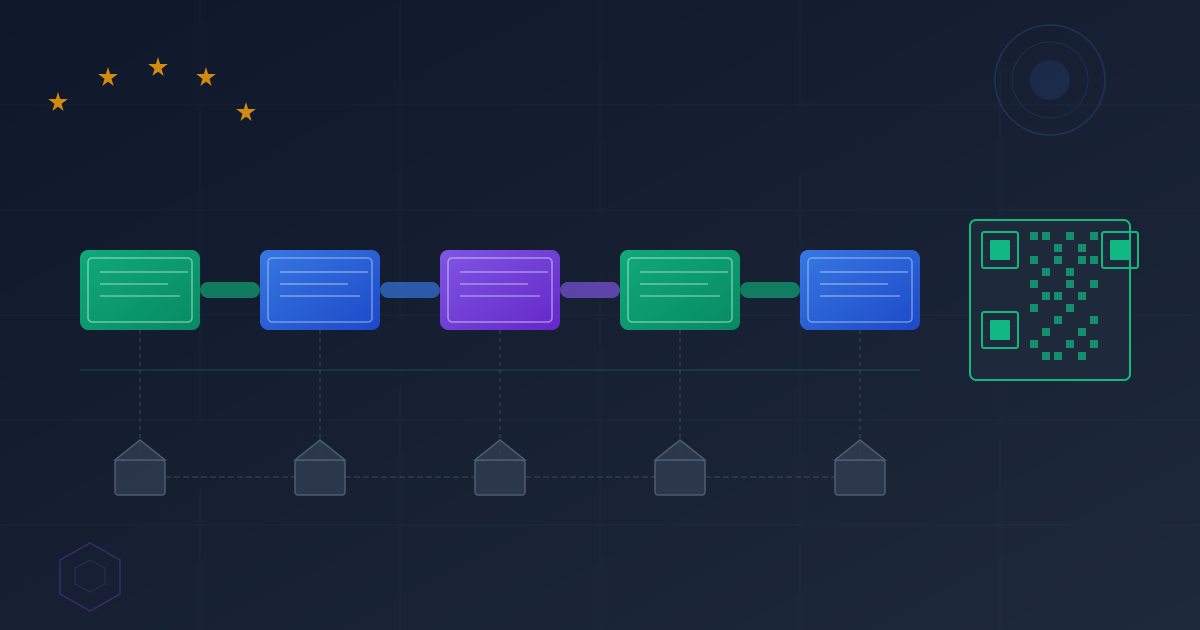
Every battery, textile, and aluminium product sold inside the EU is about to come with a blockchain-verified identity. This isn't a pilot program or a voluntary initiative — it's a regulatory mandate with hard deadlines, and one blockchain network has already processed over 300,000 product events to prove it can handle the load.
VeChain's work with enterprise data platform Rekord and the University of Sheffield's Advanced Manufacturing Research Centre (AMRC) positions it as the early frontrunner for EU Digital Product Passport (DPP) infrastructure. With the central EU registry launching around July 2026 and mandatory battery compliance kicking in February 2027, the window to build compliant systems is closing fast.
This is what the mandate requires, how VeChain's architecture handles it, and what challenges still stand in the way.
What Is the EU Digital Product Passport?
The EU Digital Product Passport is a machine-readable record tied to each physical product. It contains the product's composition, origin, environmental footprint, repairability score, and end-of-life handling instructions — all verifiable, all tamper-proof.
The legal anchor is Regulation (EU) 2024/1781, known as the Ecodesign for Sustainable Products Regulation (ESPR). It entered into force in July 2024. The regulation builds on the older Ecodesign Directive but dramatically expands scope — from energy efficiency labels to full lifecycle traceability across virtually every manufactured good sold in the EU's 27 member states.
The goal is twofold: give consumers verified sustainability data and give regulators a tool to enforce circular economy targets. A QR code, NFC chip, or RFID tag on the product links to the DPP record. Scan it, and you get the verified story of that product's life.
The Compliance Timeline: Which Industries, When
The rollout is phased, starting with the highest-impact categories:
| Category | Mandatory Date |
|---|---|
| Industrial & EV batteries (>2 kWh) | February 18, 2027 |
| Textiles & apparel | Mid-2027 to 2028 |
| Aluminium, tyres | 2027 |
| Iron & steel | 2028 |
| Electronics & ICT | 2028–2029 |
The central EU digital registry for DPP data is scheduled to launch around July 19, 2026 — roughly three months from now. Manufacturers who wait for that launch date to start building will miss the battery deadline entirely. Certification audits, supply chain integrations, and regulatory submissions all need to happen before February 2027.
That is why companies building DPP infrastructure now — not later — have a significant advantage.
Why Blockchain Solves the Core Problem
Before evaluating VeChain specifically, it's worth understanding why a traditional database won't satisfy the DPP mandate.
The regulation doesn't just require data storage. It requires:
- Immutability — production records cannot be retroactively altered
- Multi-party attestation — suppliers, manufacturers, logistics partners, and third-party auditors all contribute verified data
- Selective disclosure — sensitive commercial information can be hidden while regulatory data remains auditable
- Interoperability — records must connect across borders, languages, and enterprise systems
Blockchain's immutable ledger, cryptographic proofs, and permissioned access architecture maps almost exactly to these requirements. A shared database controlled by one company introduces single points of trust — something regulators are specifically trying to eliminate.
VeChain's Architecture for DPP
VeChain has been building supply chain tooling since 2015. Its VeChainThor blockchain uses a dual-token model: VET for value transfer and governance, VTHO for paying transaction fees. The fee separation is deliberate — it insulates enterprise operating costs from VET price volatility, which matters when you're committing to a 5-year compliance infrastructure contract.
The DPP infrastructure VeChain built with Rekord and AMRC works in three layers:
Layer 1 — Data Collection Enterprise resource planning (ERP) systems, manufacturing execution systems (MES), and IoT sensors feed raw operational data into Rekord's API. No rebuilding existing enterprise tech stacks required — Rekord acts as a translation layer.
Layer 2 — On-Chain Attestation Rekord converts raw data into privacy-preserving cryptographic proofs and writes them to VeChainThor. Each manufacturing event, supply chain handoff, or sustainability certification becomes a new immutable block. By December 2025, this system had processed over 100,000 DPP events in a single month. The cumulative total across the partnership exceeds 300,000 events.
Layer 3 — Product Identity Each physical product receives a unique identifier — linked via QR code, NFC, or RFID. Scanning that code pulls the verified DPP record. Regulators, retailers, and consumers all see the same tamper-proof data.
The AMRC partnership adds industrial credibility. The Advanced Manufacturing Research Centre counts Boeing and Rolls-Royce among its members, and their involvement signals that DPP deployment is being stress-tested against aerospace and defence supply chain complexity — arguably the hardest environment to handle.
VeChain's Existing Enterprise Footprint
VeChain isn't an untested startup pitching DPP as a concept. It has a live enterprise network with documented deployments:
- Walmart China — food traceability, tracking produce from farm to shelf
- BMW — vehicle lifecycle documentation and parts authentication
- LVMH — luxury goods authenticity verification (anti-counterfeiting)
- DHL — logistics and cold chain tracking
- H&M — textile sustainability reporting
- Lululemon China — supply chain transparency
As of March 2026, VeChain's ecosystem has surpassed 15 million wallets across 114+ countries. The network isn't scaling up for DPP — it's already at scale.
VeChain's 2026 strategic roadmap, captured in the "2026 Manifesto: The Fight for Utility", centres on exactly this kind of regulated enterprise adoption. The Interstellar cross-chain communication layer in development will let VeChain DPP data connect to other blockchain networks, addressing interoperability requirements that regulators are increasingly interested in.
The Real-World Challenges
This is a compelling use case, but the frictions are real and worth understanding before drawing conclusions about adoption trajectories.
Cost and integration burden Small and medium manufacturers — who make up the majority of EU supply chain participants — face significant cost barriers to DPP compliance. Rekord's API layer lowers this, but there's no escaping the fact that connecting legacy ERP systems to blockchain infrastructure requires time and expertise that many suppliers lack.
Data quality upstream A DPP is only as trustworthy as the data fed into it. If a supplier enters inaccurate production data, the blockchain records that error immutably. Garbage in, garbage out — but now with a cryptographic seal. Solving this requires either IoT automation or third-party auditing, both of which add cost.
Regulatory fragmentation While ESPR covers the EU's 27 member states uniformly, global supply chains stretch across dozens of regulatory jurisdictions. A VeChain-attested DPP satisfies EU requirements, but non-EU suppliers may operate under different frameworks. Cross-border legal recognition of blockchain records is still evolving.
Competitive landscape VeChain is not the only network positioning for DPP infrastructure. Ethereum-based solutions, Polygon deployments, and private consortium chains (notably IBM Food Trust's successor projects) are all in active development. VeChain's head start is meaningful, but the market is not decided.
What the DPP Mandate Means for VET and VTHO
Here's a nuanced point that matters for those following VeChain as an investment: DPP transactions consume VTHO, not VET. Every product event written to VeChainThor burns VTHO — which is generated continuously by VET holders.
If DPP adoption scales across thousands of EU manufacturers — and the regulation will eventually mandate it for every regulated product sold in the EU — VTHO consumption could increase substantially. VET stakers generate VTHO, so higher consumption translates to higher VTHO demand, which affects the economics for long-term VET holders.
The relationship isn't linear and depends on the VTHO generation rate, transaction volume, and how VeChain Foundation adjusts economic parameters over time. But the fundamental dynamic — more regulated transactions means more VTHO burned — is structurally favourable for the VeChainThor economy if DPP adoption proceeds as mandated.
This is not financial advice. Understanding the tokenomics helps evaluate the sustainability of the use case, not the price trajectory.
Practical Takeaways
For different audiences, the DPP mandate carries different urgency:
If you're in EU manufacturing or supply chain: The February 2027 battery deadline is under 10 months away. Central registry launch is three months out. Auditing your compliance readiness now — not in Q4 2026 — is the difference between a smooth rollout and a regulatory scramble.
If you're evaluating blockchain supply chain solutions: VeChain's combination of existing enterprise partnerships, the AMRC credibility, and 300,000+ live DPP events is a real differentiator against whitepaper-only competitors. But pressure-test the data quality and upstream integration assumptions for your specific supply chain.
If you're a crypto researcher watching blockchain adoption metrics: DPP is one of the cleaner examples of regulatory-driven blockchain adoption — not speculative, not voluntary, but legally mandated. Tracking VeChainThor on-chain activity through this compliance cycle will be a revealing data point for the broader "blockchain finds its killer app" thesis.
The Bottom Line
The EU Digital Product Passport is the largest mandated blockchain deployment in history — if it lands as designed. Every regulated product sold to 450 million EU consumers will need a tamper-proof, machine-readable lifecycle record. The central registry launches in roughly three months. The first hard deadline hits in ten.
VeChain has spent a decade building exactly the infrastructure this regulation requires. The Rekord and AMRC partnership has moved from concept to 300,000+ live transactions. The enterprise deployment track record — Walmart, BMW, DHL, LVMH — is real. The challenges around data quality, SME adoption costs, and competitive pressure from other chains are also real.
What's clear is that blockchain's supply chain use case is no longer waiting for adoption. Regulation is forcing adoption. The question is which infrastructure earns the mandate's scale.
Disclaimer: This article is for informational purposes only and does not constitute financial advice. Always do your own research before making investment decisions.
Tags
Ready to start trading?
Compare top cryptocurrency exchanges and find the best platform for you.
Compare Exchanges