
Pendle and Yield Tokenization: How to Trade Future Yield as a Token
Understand Pendle Finance's PT and YT mechanics in 2026. Step-by-step guide to yield tokenization, implied APY vs real APY, stETH example, and tax implications.
apex_47
Pendle and Yield Tokenization: How to Trade Future Yield as a Token
Traditional finance has been separating bond principal from interest payments — known as "stripping" — since the 1980s. You can buy a US Treasury bond for its coupon payments without owning the principal, or own the principal without the coupon stream. Pendle Finance brought this concept on-chain, and it's become one of the most sophisticated yield management tools in DeFi.
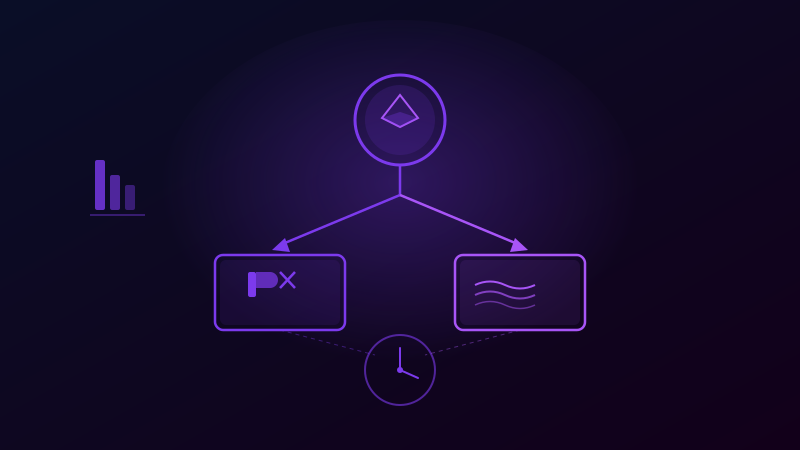
Pendle lets you split a yield-bearing asset into two tokens: one that gives you the principal back at maturity, and one that gives you all the yield generated between now and maturity. Each can be traded independently. This creates a yield curve market on-chain — something that didn't exist in DeFi before Pendle.
The PT/YT Concept Explained
When you deposit a yield-bearing asset like stETH (staked ETH) into Pendle, it splits into:
PT (Principal Token): Represents the right to redeem 1 unit of the underlying asset at a specific future date (the maturity date). If you hold PT-stETH maturing December 2026, you receive 1 stETH on December 26, 2026. No yield between now and then — you gave it up when you split.
YT (Yield Token): Represents all the yield generated by 1 unit of the underlying asset from now until maturity. If stETH yields 3.5% APR, holding 1 YT-stETH gives you that 3.5% worth of stETH over the period. YT tokens have no principal value at maturity — they expire worthless.
This split is completely reversible: if you hold both PT and YT for the same maturity, you can redeem them for the original asset before expiry.
Walkthrough: stETH on Pendle
Let's work through a concrete example with stETH at the time of writing.
Assumptions:
- stETH current yield: 3.8% APR
- Current price of 1 stETH: $2,400
- Pendle pool maturity: 6 months (December 2026)
- PT-stETH current price: $2,362 (discount to stETH)
- YT-stETH current price: $38
Why does PT trade at a discount?
PT-stETH is worth $2,362 today because it represents a promise to pay $2,400 worth of stETH in 6 months. The $38 discount represents the time value of the yield you're giving up. If the discount matches the implied yield perfectly, there's no arbitrage. If PT trades at a steeper discount, you're getting a better fixed rate.
What the math looks like:
If you buy PT-stETH at $2,362 and hold to maturity, you receive 1 stETH ($2,400). Your gain: $38 over 6 months, or roughly 3.2% annualized. This is your fixed yield rate — guaranteed regardless of what stETH's variable rate does in the interim.
If stETH's variable rate drops from 3.8% to 2%, you still earn your 3.2% fixed rate. Your fixed position wins.
If stETH's variable rate rises to 6%, you miss the upside. YT holders win in that scenario.
When to Buy PT vs YT
Buy PT when:
- You believe current implied yields are high relative to where they'll go
- You want a fixed, predictable return without variable rate risk
- You're comfortable locking capital until maturity (or selling PT on secondary)
- You want stablecoin-like behavior but with ETH exposure and DeFi yield
Buy YT when:
- You believe actual yields will exceed the current implied yield
- You want leveraged exposure to yield increases with limited capital
- You're speculating on yield going up (YT is effectively a leveraged long on yield)
- You're hedging existing yield exposure elsewhere
The YT leverage math:
YT-stETH costs $38 for exposure to 6 months of yield on 1 stETH. If stETH yields 6% instead of 3.8%, you earn approximately $72 on a $38 investment — a ~90% return on YT. But if stETH yields 2%, you earn ~$24 on a $38 investment — losing 37% on YT while the underlying stETH barely moved.
YT tokens are highly leveraged on yield movements. They are not for conservative yield seekers.
Implied vs Real APY
Implied APY (also called Fixed APY on Pendle's UI) is the yield implied by the current PT discount from par. This is what you lock in by buying PT.
Real APY (or Variable APY) is the actual yield the underlying asset has been generating, expressed as an annualized rate.
The gap between implied and real APY is the market's forward-looking view on yield. If implied > real, the market thinks yields will rise. If implied < real, the market thinks yields will fall.
In practice, Pendle's PT market provides a DeFi yield curve — you can see what the market expects yields to be at various future dates.
| Pool | Underlying | Current Real APY | Implied Fixed APY | Verdict |
|---|---|---|---|---|
| PT-stETH Dec26 | Liquid staked ETH | 3.8% | 3.2% | Market is slightly bearish on ETH yield |
| PT-eUSDe Dec26 | Ethena sUSDe | 11.2% | 9.8% | Market pricing in some yield compression |
| PT-USDC (Aave) | Aave USDC supply | 5.6% | 5.1% | Close to efficient |
Risks
Maturity risk: PT redeems at maturity for the underlying asset (e.g., 1 stETH). If stETH de-pegs from ETH before maturity, your PT redeems for de-pegged stETH. You hold the underlying asset's risk throughout.
Smart contract risk: Pendle has been audited multiple times and has operated since 2021, but all smart contract risk is present. Large positions should consider DeFi insurance coverage.
YT time decay: YT tokens lose value as they approach maturity (they become worth less as the remaining yield period shrinks), similar to options theta decay. If you're wrong about yield direction, YTs don't just underperform — they can approach zero.
Liquidity risk: Not all Pendle pools have deep liquidity. Large trades in smaller pools cause significant slippage. Check pool depth before entering.
Protocol-specific risk of underlying: Your PT/YT exposure carries the same risk as the underlying protocol. PT-stETH carries Lido stETH risk. PT-Aave-USDC carries Aave risk.
Step-by-Step: Buying PT on Pendle
Step 1: Go to app.pendle.finance. Connect your wallet (MetaMask, Rabby, or WalletConnect).
Step 2: Select the market. Browse available PT pools by underlying asset, maturity date, and current fixed APY. Sort by TVL to find liquid pools.
Step 3: Review the implied fixed APY and compare it to the real APY to understand if you're getting value.
Step 4: Enter your trade amount. The UI shows you exactly what you'll receive in PT tokens and at what effective fixed rate.
Step 5: Confirm transaction. You now hold PT tokens — they trade on secondary markets if you need liquidity before maturity, or you redeem them at maturity for the underlying.
Step 6: Track maturity date. Set a calendar reminder. Redemption is not automatic — you must manually redeem PT tokens after maturity via the Pendle interface.
Tax Implications
Yield tokenization creates complex tax situations. The key events to track:
PT purchase: When you buy PT, you're purchasing a discounted token. The discount (the implied yield) may be treated as OID (Original Issue Discount) in some jurisdictions — requiring annual accrual of income even before you realize it. US regulations on this are still unclear as of 2026.
YT income: Yield accrued on YT tokens may be treated as ordinary income as it accumulates, similar to interest income. This is the IRS's likely position, though no definitive guidance exists yet.
PT/YT disposal: Selling PT or YT before maturity is a capital gains event, with your cost basis being your purchase price.
Maturity redemption: Redeeming PT at maturity converts it back to the underlying asset — this may be a taxable event.
Consult a crypto-specializing tax professional before taking large Pendle positions. The tax treatment is genuinely uncertain and jurisdiction-dependent. Keep detailed records of all entry prices, dates, and amounts.
Summary
Pendle is one of the most innovative DeFi protocols of the current cycle. It brings institutional fixed-income mechanics — yield stripping, term structure trading — on-chain in a genuinely useful way. PT tokens give you fixed yield on blue-chip DeFi assets; YT tokens give you leveraged yield exposure. The mechanics reward understanding. Learn the implied vs. real APY gap, size YT positions knowing they're leveraged, and account for the complex tax treatment. DYOR, ape responsibly.
Tags
Ready to start trading?
Compare top cryptocurrency exchanges and find the best platform for you.
Compare Exchanges