
How Onchain AI Agents Actually Work: Virtuals, Autonolas, and the Agent Economy
Beyond the hype — how crypto AI agents actually operate onchain, manage wallets, buy compute, and earn revenue. A deep dive into Virtuals Protocol, Autonolas, and more.
WELC Team
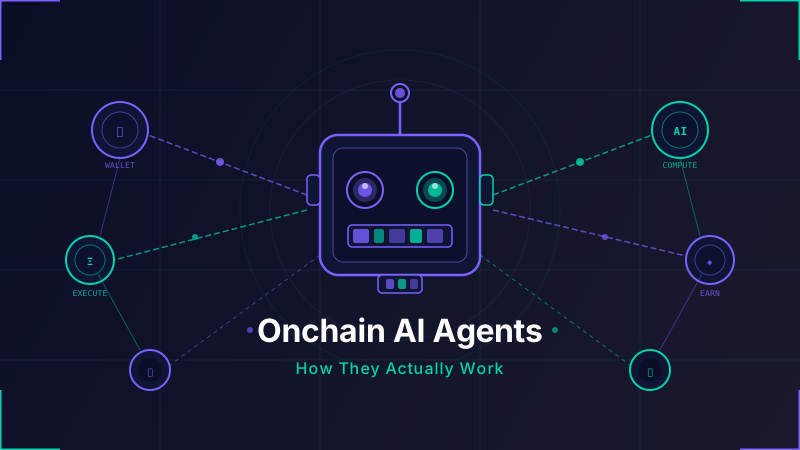
The phrase "AI agent" gets thrown around a lot in crypto — but most uses of the term describe something far less interesting than what's actually being built. A Discord bot that answers questions about a token is not an AI agent. A chatbot pinned to a project's website is not an AI agent. A GPT wrapper with a meme token attached is absolutely not an AI agent.
A real onchain AI agent is something fundamentally different: an autonomous economic actor that controls a wallet, makes decisions, executes transactions, earns revenue, and pays for the resources it needs — without a human pressing any buttons.
That distinction matters enormously for how you evaluate this space. The gap between a chatbot and an autonomous economic agent is not incremental — it's the difference between a tool and an actor. And in 2026, the infrastructure to build genuine onchain agents is finally mature enough to dissect in detail.
TL;DR
- An onchain AI agent is not a chatbot — it's an autonomous system with a wallet, a decision engine, and the ability to execute transactions, buy compute, and earn revenue independently
- Virtuals Protocol is the leading agent launchpad on Base, enabling anyone to tokenize and deploy revenue-sharing AI agents with over 500 live agents already generating fees
- Autonolas takes a services-first approach — multi-agent coordination frameworks running persistent offchain processes with onchain verification and OLAS token governance
- The agent economy thesis is that AI agents become the dominant "users" of blockchains — paying gas, buying compute, routing through DeFi — replacing humans as the primary on-chain activity generators
- Real risks include hallucination-triggered bad trades, MEV extraction by agent strategies, and deep regulatory uncertainty around autonomous financial actors
- Watch in 2026: agent-to-agent marketplaces, cross-chain agent identity standards, and whether autonomous agents can pass real auditing standards for financial services
What Is an Onchain AI Agent — Not a Chatbot, an Economic Actor
The clearest way to understand what separates a genuine onchain agent from a glorified chatbot is to look at what it can actually do autonomously:
- Hold and spend money: The agent controls a wallet with real funds — it can send tokens, pay gas fees, and approve smart contract interactions without human authorization
- Buy resources it needs: An agent that needs GPU compute can purchase time on Akash Network directly, paying in AKT with no human in the loop
- Generate revenue: Agents can charge users for services they provide — inference, data retrieval, automated trading — and receive payments into their wallet
- Interact with other agents: Agents can hire sub-agents, delegate tasks, and pay other autonomous systems for specialized capabilities
- Operate continuously: Unlike a chatbot that only responds when queried, an agent runs on a schedule or event trigger, monitoring conditions and acting when criteria are met
What makes this distinctly onchain rather than just "AI with API access" is that every economic action the agent takes is recorded on a public ledger. You can audit what an agent spent money on. You can verify its decision history. You can build trust models around its on-chain behavior — which is impossible with a black-box API call.
This is why blockchain infrastructure isn't just a funding mechanism for AI projects. It's the operational substrate that makes agent behavior verifiable and auditable at scale.
The Anatomy of an AI Agent: Wallet, Decision Engine, Execution Layer
Every functional onchain AI agent has three distinct layers working together:
1. The Wallet Layer
- A programmable wallet (often an ERC-4337 smart account) that the agent controls
- Holds assets, receives revenue, pays for compute and gas
- May have spending limits, multi-sig requirements, or guardian controls for safety
- Examples: Safe smart accounts, Coinbase Smart Wallet, or custom contract wallets
2. The Decision Engine
- The AI model(s) that process inputs and decide what actions to take
- Could be a fine-tuned LLM, a specialized classification model, a reinforcement learning policy, or a combination
- Receives data feeds: market prices, onchain events, user requests, sensor data
- Outputs actions: "buy X tokens," "post this message," "pay this invoice," "delegate this task"
3. The Execution Layer
- The interface between agent decisions and onchain reality
- Translates AI decisions into actual transaction calldata
- Manages gas, handles failures and retries, logs outcomes for future learning
- Often uses intent frameworks, account abstraction, or specialized execution APIs
The hardest engineering problem in onchain agents is the execution layer — specifically, making it safe enough that a hallucinating model can't accidentally drain its own wallet or execute a catastrophic trade. This is where most of the serious technical work is happening in 2026.
A Concrete Walkthrough: One Agent's Automated Day
Let's trace what a sophisticated onchain AI agent might actually do across a 24-hour cycle. This is not theoretical — each of these individual actions is possible today with existing infrastructure:
06:00 UTC — Data ingestion The agent polls Binance futures data, reads five DeFi protocol liquidity pools, ingests three RSS feeds from crypto news sources, and checks its Bittensor subnet's latest model outputs. Total cost: ~$0.003 in compute fees, paid automatically from its wallet.
06:15 UTC — Decision cycle Its XGBoost model, trained on 180 days of rolling market data, generates a probability distribution across asset movements. The decision engine cross-references the BTC regime filter (currently "risk-on") and determines an acceptable trade setup exists.
06:20 UTC — Compute purchase The agent needs additional inference capacity for a complex multi-model ensemble. It queries Akash Network's open marketplace, finds a provider at $0.12/hour, and rents GPU time — transaction executed, payment in AKT routed from its wallet.
06:25 UTC — Trade execution Using the enhanced inference, the agent executes a position on a Solana DEX through a Jupiter aggregator call. The smart account's spending limit caps the position at 5% of its total holdings. Transaction confirmed in ~400ms.
09:30 UTC — Revenue collection Three users paid the agent for its market analysis report, which it auto-generated and delivered. $47 in USDC lands in its wallet.
18:00 UTC — TAO rewards The agent's contributions to a Bittensor subnet (validated model outputs) earn 0.8 TAO in subnet rewards, automatically deposited to its wallet.
23:50 UTC — Portfolio rebalancing The agent detects its USDC balance has grown beyond its target allocation. It routes excess USDC through a Uniswap pool into ETH, then stakes into a liquid staking protocol for overnight yield.
That entire cycle — data ingestion, decision-making, compute purchasing, trading, revenue collection, and portfolio management — happened with zero human interaction. That is what an onchain AI agent actually is.
Virtuals Protocol Deep Dive: The Agent Launchpad
Virtuals Protocol (VIRTUAL token, live on Base) is the most accessible entry point into the agent economy from both a user and investor perspective. It's best understood as a launchpad and revenue-sharing infrastructure layer for tokenized AI agents.
How It Works
- Agent tokenization: Anyone can deploy an AI agent on Virtuals and attach a token to it. The token represents fractional ownership of the agent's future revenue
- Revenue sharing: When an agent earns fees (from users paying for its services), that revenue flows to token holders proportionally
- Initial Agent Offerings (IAOs): New agents launch through a bonding curve mechanism — similar to token launches but specifically designed for agent economics
- The contribution pool: Developers who improve an agent's capabilities (better models, more data, new skills) can receive token rewards from the protocol
The VIRTUAL Token
VIRTUAL is the base currency of the Virtuals ecosystem. It's used to:
- Pay for agent deployment and infrastructure costs
- Participate in Initial Agent Offerings
- Stake for governance over protocol parameters
- Earn a share of platform-level revenue as a base-layer holder
What Makes It Different
The critical insight in Virtuals' design is that AI agents are treated as productive economic assets — not just products. By attaching revenue-sharing tokens, the protocol creates aligned incentives: developers want to build better agents because better agents earn more, which increases the value of their token allocation.
By Q1 2026, Virtuals had processed over $200 million in cumulative agent token volume on Base, with more than 500 active agents generating real usage fees. The most successful agents — particularly those in the social media automation and DeFi analytics categories — were earning tens of thousands of dollars monthly in fees.
Limitations to Understand
- Most agents on Virtuals are still relatively simple — content generation, social posting, basic trading signals
- The IAO mechanism has attracted significant speculation, with many agent tokens trading on narrative rather than actual revenue
- Infrastructure costs for truly sophisticated agents (real-time data, GPU compute) can exceed early-stage revenue
- Agent quality is highly variable — the protocol is permissionless, meaning low-quality agents launch alongside excellent ones
Autonolas Deep Dive: The Service Framework
Autonolas (OLAS token) takes a fundamentally different approach. Where Virtuals is a marketplace for individual agents, Autonolas is an infrastructure protocol for building coordinated multi-agent services.
The Core Architecture
Autonolas is built around three primitives:
1. Agent Services Rather than single agents, Autonolas deploys "services" — coordinated collections of agents running together to achieve a goal. Each service has defined roles, quorum requirements, and a shared state that agents synchronize over.
2. Offchain Computation with Onchain Settlement Autonolas agents do their heavy computation offchain (where it's fast and cheap), but their outputs and state transitions are periodically committed to a blockchain. This gives you efficiency without sacrificing verifiability.
3. The FSM (Finite State Machine) Approach Agent behavior in Autonolas is defined as explicit state machines — the agent moves through defined states based on inputs and outputs. This is more constrained than a pure LLM agent but also far more predictable and auditable.
Real Deployments
Autonolas already has production deployments worth examining:
- Olas Predict: A decentralized prediction market service where agent swarms gather information and make probabilistic forecasts — live on Gnosis Chain
- Mech Marketplace: Agents-as-a-service for offchain computation tasks, paid in crypto
- Autonomous Trading: The first autonomous treasury management services for DAOs, running fully onchain governance execution
OLAS Tokenomics
The OLAS token is central to Autonolas' economic model:
- Developers who contribute agent components and services receive OLAS rewards
- Operators who run agent services stake OLAS as collateral, aligning economic incentives with uptime
- Bond mechanism: Staking OLAS creates protocol-owned liquidity, reducing dependency on mercenary capital
The tokenomics are meaningfully more sophisticated than typical governance tokens — OLAS has actual utility as collateral and as a reward mechanism for productive work, not just as a voting token.
Other Players in the Agent Economy
AI16Z and the Eliza Framework
AI16Z (the VC parody DAO turned serious project) built the Eliza framework — an open-source TypeScript framework for building AI agents with memory, tool use, and multi-agent coordination. Eliza became the dominant open-source agent framework in late 2025, spawning hundreds of derivative projects.
Key capabilities:
- Long-term memory across conversations via vector database integration
- Tool plugins for onchain actions (wallet management, DEX interaction, NFT minting)
- Multi-agent room coordination — multiple Eliza agents can collaborate in shared contexts
- Social media integration out of the box (Twitter/X, Discord, Telegram)
The AI16Z token is attached to the DAO that funds Eliza development, making it something between a governance token and a bet on the Eliza framework's adoption.
ARC (AI Research Collective)
ARC focuses on the coordination layer between agents — specifically, how agents discover each other, establish trust, and negotiate service agreements without human intermediaries. Their work on agent reputation systems and the "agent web of trust" is technically important even if it hasn't attracted the same speculative attention as Virtuals.
Zerebro
Zerebro gained early attention as one of the first agents with genuine creative output — it produced music and art that found real audiences, with its wallet receiving payments for that creative work. More interesting as a proof of concept than as infrastructure, but it demonstrated that agent revenue from creative work was viable.
Platform Comparison
| Feature | Virtuals Protocol | Autonolas | AI16Z / Eliza |
|---|---|---|---|
| Primary approach | Agent tokenization + launchpad | Multi-agent service framework | Open-source agent toolkit |
| Chain | Base (Ethereum L2) | Multi-chain (Gnosis, Ethereum, Solana) | Chain-agnostic (framework) |
| Token | VIRTUAL | OLAS | AI16Z |
| Best use case | Revenue-sharing consumer agents | Enterprise/DAO coordination services | Developer framework for custom agents |
| Barrier to launch | Low — permissionless IAO | Higher — requires service design | Medium — coding required |
| Revenue model | Agent fee sharing | Operator staking rewards | DAO treasury funding |
| Production deployments | 500+ agents live | Several DAO treasury services | Hundreds of Eliza-based projects |
Why "The Agent Economy" Thesis Is More Than Hype
The most bullish argument for onchain AI agents is not about any individual project — it's structural. Consider what happens at scale if autonomous agents become meaningful economic actors:
- Agents pay gas: Every action an agent takes generates transaction fees. If millions of agents are running thousands of daily transactions each, that's an enormous new source of base-layer demand that is fundamentally different from human-driven speculation
- Agents buy compute: Decentralized compute networks like Akash and Render become essential infrastructure as agents purchase GPU time — demand that scales with agent capability requirements, not human adoption cycles
- Agents provide liquidity: Agents running treasury management and yield optimization strategies could become a major source of DeFi liquidity, with more consistent behavior than human yield farmers
- Agents generate data: Every agent interaction creates structured, verifiable data that can train future models — creating a flywheel where better agents generate better training data
The 2025 data already shows early signals. Onchain activity from identified bot/agent addresses rose approximately 340% year-over-year across major EVM chains. On Solana, automated agents account for an estimated 60-70% of DEX volume by transaction count (though a smaller percentage by value).
The key question is not whether agents will be economically significant — they already are. The question is which infrastructure layer captures the most value from that activity.
Risks: Where Onchain Agents Can Go Wrong
Hallucination + Money = Real Losses
Large language models hallucinate. When a hallucinating model controls a wallet, hallucination isn't just an inconvenience — it's a financial event. An agent that confidently executes a trade based on data it fabricated, or calls a contract function that doesn't exist, or misinterprets a price feed, can lose real money very quickly.
Mitigation approaches include:
- Spending limits and circuit breakers at the wallet level
- Multiple model consensus before executing high-value actions
- Human-in-the-loop requirements above threshold amounts
- Formal verification of execution layer logic
None of these are fully solved. This is the most serious technical risk in the space.
MEV Extraction By (and Against) Agents
As agents become more sophisticated DeFi participants, they become both victims and perpetrators of MEV (Maximal Extractable Value). A well-capitalized agent running latency-optimized strategies can front-run slower agents. The emergence of agent-vs-agent MEV dynamics is an underappreciated risk that could create a winner-take-most dynamic in automated trading.
Regulatory Uncertainty
Autonomous agents that execute financial transactions occupy a deeply ambiguous legal position. Questions that remain unresolved:
- Is an agent acting as an unlicensed broker when it executes trades on a user's behalf?
- Who is liable when an agent loses user funds — the developer, the infrastructure provider, or the user?
- Do revenue-sharing agent tokens constitute unregistered securities?
- Can an agent be a legal counterparty in a contract?
No major jurisdiction has addressed these questions clearly. The legal framework for autonomous financial agents is years behind the technical reality.
What to Watch in 2026
- Agent-to-agent marketplaces: Standardized protocols where agents can hire other agents for specialized tasks — think an API economy but for AI capabilities, settled onchain
- Cross-chain agent identity: Portable identity standards so an agent's reputation on Base is recognized on Solana or Ethereum mainnet
- Agent auditing standards: Whether serious institutional DeFi protocols will accept autonomous agent counterparties — and what audit requirements will look like
- Bittensor + Virtuals integration: Agents that source their inference from Bittensor subnets rather than centralized API providers, creating a fully decentralized agent stack
- Regulatory first movers: Which jurisdiction moves first to create a legal framework for autonomous financial agents — likely Bermuda, Singapore, or the EU's MiCA extension discussions
- The killer agent: A single autonomous agent deployment that generates north of $1M/month in verifiable, audited revenue would do more for the space than any whitepaper
Sources
- Virtuals Protocol documentation and Base blockchain analytics, Q1 2026
- Autonolas technical documentation: docs.autonolas.network
- AI16Z Eliza framework GitHub repository: github.com/ai16z/eliza
- Grayscale AI Crypto Sector Index, March 2026 market report
- Base network onchain analytics: Dune Analytics agent activity dashboards
- Bittensor documentation: docs.bittensor.com
- Akash Network compute marketplace documentation
- Onchain AI: The New Economic Primitive — Multicoin Capital research note, February 2026
- DeFi Llama agent protocol TVL and volume data, April 2026
Tags
Ready to start trading?
Compare top cryptocurrency exchanges and find the best platform for you.
Compare Exchanges