
Hyperliquid Explained 2026: How an On-Chain Perp DEX Became a Top-10 Crypto
Hyperliquid runs a full central limit order book onchain, clears billions in daily perp volume, and airdropped HYPE to users instead of VCs. Here is how the architecture actually works, how HyperEVM fits in, and what could break it.
WELC Team
For most of crypto's history, a simple claim has held: you cannot run a real order book fully onchain. Block times are too slow, gas is too expensive, and MEV extraction turns every match into a toll booth. So "on-chain perpetuals" always meant one of two compromises — either an AMM pretending to be a perp venue (GMX, Gains), or an off-chain matching engine with onchain settlement (dYdX v3, early Vertex).
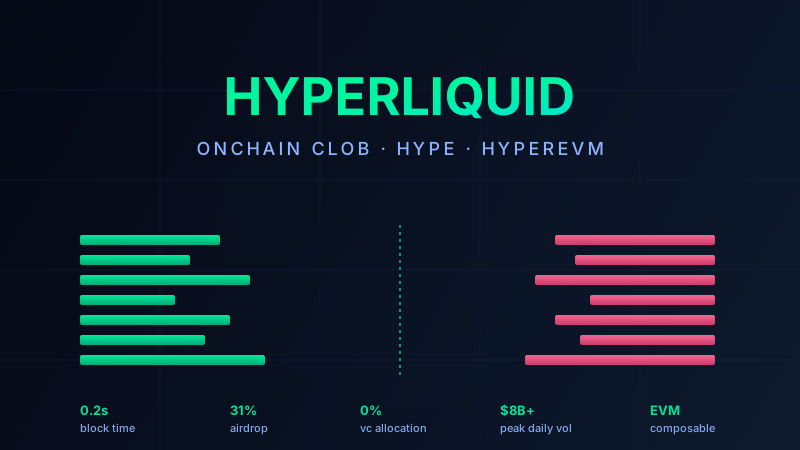
Hyperliquid broke that premise. It runs a classical central limit order book — the same architecture Binance and Coinbase use — entirely on its own Layer 1, with sub-second finality and zero gas for takers. In 2026, that architectural bet turned into a protocol clearing more than $8 billion of perp volume on its best days, a native token (HYPE) in the top 10 by market cap, and a permissionless EVM (HyperEVM) that lets anyone deploy contracts directly alongside the order book state.
This post is a deep look at how the thing actually works, why the airdrop became a case study in community alignment, what HyperEVM unlocks, and the specific risks that could still break the model.
TL;DR
- Hyperliquid is a Layer 1 built for one job: running a fully on-chain central limit order book for perps and spot, with ~0.2 second block times and gasless takers
- HyperBFT consensus is a HotStuff-style BFT built from scratch in Rust, tuned for order book throughput — not a generic L1 retrofitted for trading
- The HYPE airdrop distributed 31% of supply (310M tokens) to users with zero VC allocation — one of the largest user-aligned distributions in crypto history
- HyperEVM launched in early 2026, giving developers an EVM environment that can read the order book's native state, enabling "DeFi on top of an exchange" composability
- HLP, the liquidity vault, lets anyone deposit USDC and become the house — earning maker fees and liquidation profits that were previously captured by market makers
- The real risks are centralization of validators, dependency on a small core team, oracle manipulation on thin markets (seen in the JELLY incident), and regulatory exposure as volume grows
What Problem Hyperliquid Is Actually Solving
The short version: traders want a CEX experience with DEX custody, and every previous attempt has traded away one to get the other.
Look at the design space before Hyperliquid:
| Venue | Matching | Settlement | Trade-off |
|---|---|---|---|
| Binance perps | Off-chain CLOB | Off-chain custody | Best UX, full custodial risk |
| dYdX v3 | Off-chain CLOB | Onchain (StarkEx) | Custody OK, matching is a black box |
| GMX | Onchain AMM | Onchain | Real custody, but LPs eat the PnL of winning traders |
| Vertex | Hybrid (off-chain match, onchain clear) | Onchain | Faster than AMMs, still a trusted matcher |
| Hyperliquid | Onchain CLOB | Onchain | Full transparency — if the L1 can actually keep up |
The "if the L1 can actually keep up" caveat is the entire technical story. Running a real order book means every limit order placement, cancel, and match has to be processed, ordered, and finalized fast enough that a professional market maker can quote tight spreads without getting picked off. Ethereum L1 can do maybe 15 transactions per second. A busy market maker can easily send 50 order updates per second on a single pair.
Hyperliquid's answer was to stop trying to run this on a general-purpose chain and build a specialized one.
The Architecture: HyperBFT and a Purpose-Built L1
Hyperliquid's L1 is not an EVM fork, not an app-chain on someone else's stack, and not a rollup. It is a bespoke chain written in Rust with a custom consensus algorithm called HyperBFT, derived from the HotStuff family of BFT protocols.
The important properties:
- Block time ~0.2 seconds with single-slot finality — no reorgs, no waiting for confirmations
- Throughput targeted at 200,000 orders per second at the consensus layer, with current live load running well below that
- ~21 validators (growing toward a larger set) running geographically distributed, staking HYPE
- Gasless taker trades — taker fees are paid in the traded asset and recycled to HLP, stakers, and the insurance fund
What this looks like in practice: you open Hyperliquid, connect a wallet, place a limit order, and see it appear in the book within a single block — roughly the latency of a Web2 exchange, with no cross-chain bridging, no centralized sequencer, and no trusted off-chain matcher.
Why not just use an existing fast L1?
Solana has fast blocks. Sui and Aptos have parallel execution. Why build a whole new chain?
The answer is that a CLOB has a specific state access pattern that is brutally bad for general-purpose chains. Every order touches the same bid/ask books. Every liquidation touches shared risk state. Parallel execution helps when state is sharded across many users — it does nothing when a thousand makers are all writing to the same ETH-USD order book.
By building the chain around the matching engine rather than retrofitting the engine onto a chain, Hyperliquid gets to optimize the state layout, the gossip protocol, and the block construction rules for one workload.
The HYPE Airdrop: A Distribution That Mattered
On November 29, 2024, Hyperliquid launched HYPE with an allocation almost no major crypto project has dared match:
- 31% to the community airdrop — distributed to users based on pre-launch trading activity
- 38.88% reserved for future community emissions — not a team-controlled treasury
- 23.8% to team and contributors — with multi-year vesting
- 6.0% to the Hyper Foundation
- 0% to venture investors — Hyperliquid took no outside funding before launch
Measured in dollars at the peak, individual airdrop recipients received six- and seven-figure allocations. More importantly, the cap table walked into token generation with no VC unlocks scheduled to dump on the community — a structural difference that shows up in the price chart every time a comparable project hits a cliff.
In 2025 and into 2026, HYPE became one of the clearest case studies for the "user ownership" thesis: that crypto products distributed to the people who actually use them create a fundamentally different price dynamic than ones distributed to investors who want to exit.
Why the distribution shape matters
A token distribution is a schedule of future sellers. When 40% of supply is held by funds whose LPs demand liquidity at specific dates, you can plot the dump calendar years in advance. When the same supply sits in the hands of thousands of traders with no coordinated exit, the selling is noisier, less cliffy, and often offset by continuing buying from new users who want in.
This is not a guarantee that HYPE goes up. It is a structural claim that the reason HYPE goes down looks different than the reason a VC-backed token goes down.
HLP: Becoming the House
HLP (Hyperliquid Liquidity Provider) is the mechanism that makes much of this work. It is a USDC-denominated vault that any user can deposit into. The vault acts as a market maker and liquidation counterparty on Hyperliquid, running strategies that a professional prop shop would normally run privately.
What HLP earns:
- Maker rebates from providing liquidity on the order book
- Funding rate capture when open interest is one-sided and funding pays the short side (or long)
- Liquidation profits — when a trader gets liquidated, HLP is often the taker of the closing trade at a favorable price
- Spread capture on spot/perp basis arbitrage
Depositors receive a share of the vault's PnL in proportion to their USDC contribution. The strategies are coded and operated by the core team, which is both the reason HLP works well and the single largest centralization risk in the protocol — a point I'll return to.
Historical HLP APY has ranged from roughly 10% to 40% depending on volume and volatility. That is capital-at-risk yield — HLP absolutely can take drawdowns, and did during the JELLY incident — but the risk profile is very different from buying a governance token or staking in a DeFi vault.
HyperEVM: DeFi Rebuilt On Top of an Exchange
In early 2026, Hyperliquid launched HyperEVM — a fully EVM-compatible execution environment that runs alongside the native order book. The design choice that matters is that HyperEVM contracts can read the state of the native L1 directly, including live order book prices, funding rates, and user positions.
This sounds like a technical footnote. It is not. Here is what it changes:
- Lending protocols can use Hyperliquid's real mark prices as oracles — no Chainlink latency, no stale spot feeds
- Options vaults can delta-hedge on Hyperliquid perps inside a single block, eliminating the hedging lag that plagues most onchain options
- Yield aggregators can deposit idle collateral into HLP without bridging it anywhere
- Structured products can wrap a position that would previously have required off-chain infrastructure — covered calls, barrier options, principal-protected notes — with live mark-to-market
The dApps ecosystem on HyperEVM in early 2026 is still small compared to Ethereum or Solana, but the composability model is genuinely different. Every other DeFi ecosystem is composing AMMs with AMMs. HyperEVM is composing contracts on top of a real matching engine.
What's already live
As of mid-April 2026, the HyperEVM ecosystem includes:
- HyperLend — money market with HLP and HYPE as collateral
- Kinetiq — liquid staking for HYPE validators
- Felix — CDP stablecoin using HLP as collateral
- HypurrFi — leveraged HLP looping vaults
- Multiple DEX aggregators routing between HyperEVM AMMs and the native order book
The pattern across almost all of these: use the native L1 order book as the pricing primitive, and build the structured product in EVM.
The JELLY Incident: What Went Wrong and What It Revealed
In March 2025, a trader opened a large short position on JELLY — a thinly-traded memecoin listed on Hyperliquid — and then ran up the price of JELLY on external venues to force their own liquidation. Because JELLY's open interest was large relative to its onchain liquidity, the liquidation cascade would have forced HLP to take the other side at a devastating loss.
The Hyperliquid validators responded by voting to delist JELLY, settling all open positions at a price they selected, and effectively reversing the exploit. HLP came out roughly neutral. The attacker did not profit.
This was the right outcome economically. It was also the clearest demonstration anyone has seen of what "decentralized" actually means on a young chain: when the protocol faces an existential loss, the validators can and will step in.
What the incident exposed:
- Listing criteria matter. Thinly-traded assets with open interest disconnected from spot liquidity are attack surface
- Oracle design is the whole game. Hyperliquid has since tightened how reference prices are constructed for less liquid listings
- Validator intervention is a feature, not a bug — but only if you trust the validators. The willingness to delist a market is also the power to censor one
Every major derivatives protocol eventually faces its JELLY moment — dYdX had Mango-adjacent scares, GMX has had oracle-manipulation attempts, Binance has socialized losses via the insurance fund. The question is never whether these events happen. The question is whether the response is transparent and rule-based or ad hoc.
How HYPE Accrues Value
Unlike most L1 tokens that bundle gas, governance, and staking into a vague value proposition, HYPE has a mechanically specific claim on protocol cash flows:
- Trading fee buybacks: A significant portion of protocol fees is used to buy HYPE from the market and burn or redistribute it
- Staking yield: HYPE stakers secure the chain and earn a share of emissions plus fees
- Validator rewards: Validators must stake HYPE to produce blocks
- Future HyperEVM gas: HYPE is the gas token for HyperEVM transactions
The on-paper math gets interesting when you compare fees-per-token to valuations elsewhere in the market. Hyperliquid did multi-billion-dollar daily volumes through 2025 and into 2026. Even modest take rates translate into annualized fee revenue that stacks up against top 20 crypto assets. Whether that revenue fully accrues to HYPE holders depends on how aggressively buybacks and burn persist over time — which is ultimately a governance and team-discretion question.
This is not investment advice. It is an observation that HYPE is one of the few tokens where the revenue link is precise enough to argue about honestly.
The Centralization Questions Honest Observers Ask
Hyperliquid works unusually well, and skepticism should scale with how well something works.
Validator set size. The active validator count is still small by the standards of Ethereum or Cosmos. A larger set is roadmapped but not yet live. Until it is, the trust assumption is closer to a fast BFT chain than a permissionless one.
Core team dependency. The matching engine, HLP strategies, and most protocol upgrades come from a very small team. If that team disappeared, it is not clear the chain would continue to operate with its current performance profile.
Open source status. Hyperliquid has progressively open-sourced more of its stack through 2025 and 2026, but the full node software and HLP strategies are not all public in the way Ethereum's clients are. Verification of the chain's behavior is possible via consensus but harder than on fully open protocols.
Listing authority. Markets are added and occasionally removed by a process that is transparent in outcome but not fully in selection. The JELLY delisting was defensible; a future delisting aimed at a legitimate project would test community consent.
None of these are disqualifying. They are real risks that an honest analyst names out loud.
Who Should Care About Hyperliquid
Active perp traders. If you are sending six-figure notional through centralized perp venues, Hyperliquid is at this point a first-tier alternative on execution quality. The spread on BTC and ETH is routinely comparable to Binance, with self-custody.
Passive yield seekers. HLP is one of the few places in crypto where a retail user can deposit stablecoins and receive yield that comes from a real, auditable business — running a market-making book — rather than from emissions or shadowy strategies.
DeFi builders. HyperEVM's ability to read live order book state is a genuinely different primitive. If you are designing structured products, options, or lending protocols that need real-time pricing, Hyperliquid removes an entire category of oracle problem.
Longer-term observers. Whether or not you trade there, Hyperliquid is the most successful attempt so far to prove that a fully on-chain CEX-grade experience is possible. If it keeps working, it reshapes what "onchain" can credibly mean.
What to Watch Through 2026
- Validator decentralization rollout — whether the set grows from ~21 toward the 50-100 range without degrading block times
- HyperEVM TVL — the rate at which serious DeFi protocols migrate or deploy natively is the clearest signal of composability value
- Fee capture policy — whether HYPE buybacks maintain pace as emissions taper and volume moderates from peak
- Regulatory posture — fully on-chain perps operating at Binance-scale volumes will draw scrutiny from multiple jurisdictions, and how Hyperliquid positions itself matters
- Competing CLOB L1s — several projects are racing to replicate or extend the model; the question is whether Hyperliquid's lead in liquidity and community ownership is structural
The bet underneath Hyperliquid is simple: the exchange is the most important application in crypto, and the exchange should live on a chain that is as good as the exchange itself. In 2026, that bet is looking less like a thesis and more like a fact on the ground.
Want a plain-English walkthrough of how perp funding rates work before you trade? Read our Crypto Options Strategies for Holders guide, or see our Best Crypto Staking Platforms 2026 breakdown for passive yield comparisons.
Tags
Ready to start trading?
Compare top cryptocurrency exchanges and find the best platform for you.
Compare Exchanges