
Restaking and EigenLayer: Is It Worth the Risk? A Practical Guide for 2026
Learn how EigenLayer restaking works, compare liquid restaking protocols, analyze real yields vs risks, and follow step-by-step instructions to start restaking ETH in 2026.
WELC Team
Restaking and EigenLayer: Is It Worth the Risk? A Practical Guide for 2026
Ethereum staking yields around 3.2-3.8% APR in early 2026. That number has been slowly compressing since the Merge, and stakers are looking for more. Restaking promises to change the math by letting you use already-staked ETH to secure additional protocols, earning extra yield on the same capital.
EigenLayer sits at the center of this movement with over $15 billion in total value restaked. But extra yield never comes free. Restaking introduces new layers of smart contract risk, slashing conditions, and complexity that most guides gloss over.
This article breaks down how restaking actually works, maps the ecosystem as it stands in 2026, analyzes what restakers really earn, and gives you a concrete framework for deciding whether the risk is worth it.
Restaking 101: What It Is and Why It Exists
Traditional Ethereum staking works like this: you lock 32 ETH (or use a liquid staking protocol), validators attest to blocks, and the network pays you for providing security. Your staked ETH secures one thing: the Ethereum network.
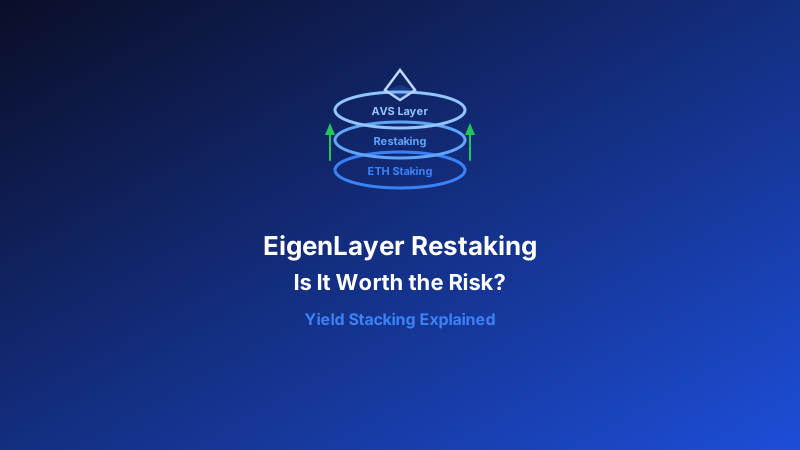
Restaking extends this model. Instead of your staked ETH only securing Ethereum, it can simultaneously be used as collateral to secure other protocols called Actively Validated Services (AVSs). Think of it as your security deposit doing double duty. You post the same ETH as collateral, but now two (or more) systems can slash you if you misbehave.
The reason this exists is economic. New protocols that need security, whether they are oracle networks, data availability layers, bridges, or rollup sequencers, previously had to bootstrap their own validator sets and token incentives from scratch. This is expensive and results in fragmented, weaker security. By tapping into Ethereum's existing staker base, AVSs can rent security from the largest proof-of-stake network without building from zero.
EigenLayer is the middleware that makes this possible. It sits between Ethereum's consensus layer and the AVSs, managing the delegation, slashing, and reward distribution mechanics.
The Key Players
EigenLayer is the core protocol: the smart contract layer on Ethereum where stakers opt in to securing AVSs. It handles the relationship between restakers, operators, and AVSs.
Operators are entities that run the actual validation software for AVSs. When you restake, you delegate to an operator who does the computational work. The operator's performance determines whether you get slashed.
AVSs (Actively Validated Services) are the protocols that pay for security. Examples include EigenDA (data availability), AltLayer (rollup infrastructure), Omni Network (cross-chain messaging), Brevis (ZK coprocessor), and Witness Chain (proof of location). As of early 2026, there are over 20 live AVSs with slashing enabled on mainnet.
The Restaking Ecosystem Map
The restaking ecosystem has matured significantly since EigenLayer's mainnet launch. Here is how the major pieces fit together.
EigenLayer (Native Restaking)
Native restaking means pointing your Ethereum validator's withdrawal credentials directly to an EigenLayer smart contract called an EigenPod. This approach gives you the most direct exposure with no intermediary token, but it requires running a full 32 ETH validator or using a node operator service.
Liquid Restaking Protocols
Most restakers do not run their own validators. Instead, they use liquid restaking tokens (LRTs), which work similarly to liquid staking tokens like stETH but add the restaking layer on top. You deposit ETH (or an LST like stETH), receive a liquid token in return, and the protocol handles the operator delegation and AVS selection.
EtherFi (eETH/weETH) remains the largest liquid restaking protocol by TVL, holding roughly $5 billion in restaked assets. EtherFi differentiates by operating its own node infrastructure, and weETH has become one of the most widely integrated DeFi tokens, accepted as collateral on Aave, Morpho, Pendle, and dozens of other protocols. Their fee structure takes 10% of restaking rewards.
Renzo (ezETH) focuses on a multi-chain approach, with restaked assets available on Ethereum, Arbitrum, and Base. Renzo's strategy emphasizes AVS diversification, spreading risk across multiple services rather than concentrating on one or two. TVL sits around $2.5 billion.
Puffer Finance (pufETH) differentiates through anti-slashing technology, specifically their Secure-Signer implementation that runs validator keys inside a trusted execution environment to reduce the chance of slashable offenses. Puffer has been particularly aggressive on Ethereum alignment and has roughly $1.5 billion in TVL.
Kelp (rsETH) by Stader Labs provides a restaked token that represents a basket of underlying LSTs restaked on EigenLayer. This gives exposure to multiple operators and AVSs through a single token. TVL is around $1.2 billion.
Swell (rswETH) combines its liquid staking product (swETH) with restaking. Swell has been building toward its own L2 rollup, creating a vertically integrated staking-restaking-L2 stack.
Beyond EigenLayer
EigenLayer is not the only restaking game. Symbiotic launched in mid-2025 with a more modular design, allowing any ERC-20 token to be used as restaking collateral, not just ETH or LSTs. Symbiotic has attracted around $3 billion in TVL and is backed by Lido's parent entity, creating an interesting competitive dynamic.
Karak takes a multi-asset approach similar to Symbiotic, and has expanded to support restaking on multiple chains including Arbitrum and BNB Chain.
Real Yield Analysis: What Restakers Actually Earn
This is where most guides fail you. They talk about potential yields without grounding the numbers in reality. Here is what restaking actually pays in early 2026.
Base Ethereum Staking Yield
Plain ETH staking through Lido or Rocket Pool yields approximately 3.2-3.8% APR. This is your baseline, the return for just staking without restaking.
Additional Restaking Yield
The extra yield from restaking comes from AVS payments. These payments arrive in a mix of ETH, EIGEN tokens, and AVS-native tokens. Here is the honest breakdown:
- EigenDA: The largest AVS by restaked TVL, paying approximately 1.5-2.5% additional APR in EIGEN and ETH rewards
- Other major AVSs (AltLayer, Omni, Brevis): Each contributing 0.3-0.8% APR, though this varies significantly by epoch
- Smaller AVSs: Often paying in their own tokens, which can range from near-zero to significant but volatile rewards
Total realistic yield for a diversified restaker in early 2026: 5-7% APR, compared to 3.2-3.8% for plain staking. That is an incremental 1.5-3.5% for the additional restaking risk.
The Yield Compression Problem
In 2024, restaking yields were dramatically higher because protocols were distributing points and retroactive airdrops. The EIGEN airdrop alone provided outsized returns to early restakers. Those days are over. As more capital flows into restaking, the yield per dollar of restaked ETH naturally compresses.
The AVS fee market is still developing. Most AVSs are not yet generating enough organic revenue to pay high rewards indefinitely. A significant portion of restaking rewards still comes from token emissions rather than real protocol revenue. This is a critical distinction: emission-based rewards are inherently temporary, while fee-based rewards are sustainable.
Comparison: Is the Extra Yield Worth It?
Plain staking at 3.5% on a base of $100,000 in ETH earns $3,500 per year. Restaking at 6% earns $6,000 per year, an extra $2,500. The question is whether that $2,500 justifies the additional risk layers described below.
Risk Framework: What Can Actually Go Wrong
Restaking introduces multiple new risk vectors beyond normal staking. Here is a thorough assessment.
Slashing Risk
Slashing is the mechanism where a portion of your staked ETH is destroyed as punishment for misbehavior. In restaking, you face slashing conditions from both Ethereum consensus and from each AVS you secure.
Theoretical risk: Each AVS defines its own slashing conditions. An operator running faulty software for an AVS could trigger slashing that affects all the ETH delegated to them for that AVS.
Actual risk in 2026: Slashing on EigenLayer has been live since late 2025. As of March 2026, there have been two minor slashing events, both involving operator misconfiguration on smaller AVSs, with affected restakers losing less than 0.5% of their stake. The fact that slashing exists and has happened is important: this is not theoretical risk anymore.
The key variable is operator quality. Restaking with a top-tier operator like P2P, Figment, or EtherFi's own infrastructure significantly reduces slashing risk compared to smaller, less proven operators.
Smart Contract Layering Risk
Every layer in the restaking stack adds smart contract risk. Consider what a liquid restaker is exposed to:
- Ethereum consensus layer (battle-tested)
- EigenLayer core contracts (audited, bug bounty, 18+ months on mainnet)
- Liquid restaking protocol contracts (variable maturity)
- Individual AVS contracts (newest, least tested)
- DeFi integrations if using LRTs as collateral (Aave, Morpho, etc.)
A bug in any layer can affect your funds. While EigenLayer's core contracts have been through extensive audits and time on mainnet, the AVS contracts are newer and less battle-tested. Using an LRT as collateral on a lending protocol adds yet another layer.
Liquidity and Exit Risk
Liquid restaking tokens like weETH, ezETH, and pufETH are supposed to be redeemable for ETH. In normal markets, they trade close to peg. During stress events (market crashes, protocol exploits), LRTs can temporarily depeg.
In March 2025, ezETH briefly traded at a 3% discount during a broad market selloff. While it recovered, anyone who needed to exit during that window took a loss. If you are using LRTs as collateral for borrowing, a depeg can trigger liquidation even if the underlying ETH value has not changed.
The redemption queue is another factor. Native restaking through EigenLayer has an unbonding period of approximately 7 days. During high-demand exit periods, this could extend. Liquid restaking tokens can be sold on the open market instantly, but only at whatever price the market offers.
Operator Selection Risk
Your choice of operator matters enormously. Operators vary in:
- Infrastructure quality: Uptime, geographic distribution, redundancy
- AVS coverage: Which AVSs they validate for (more AVSs = more yield but more slashing exposure)
- Commission rates: Typically 5-10% of restaking rewards
- Track record: How long they have been running without incidents
Delegating to an unknown operator running maximum AVSs for maximum yield is the highest-risk approach. A conservative strategy delegates to established operators running a curated set of well-audited AVSs.
Step-by-Step: How to Restake via Liquid Restaking Tokens
Here is the practical walkthrough for restaking through EtherFi, the largest liquid restaking protocol. The process is similar for Renzo, Puffer, and others.
Prerequisites
- An Ethereum wallet (MetaMask, Rabby, or hardware wallet)
- ETH on Ethereum mainnet (or stETH if you already have a liquid staking position)
- Enough ETH for gas fees (typically $5-15 for the deposit transaction)
Step 1: Navigate to the Protocol
Go to app.ether.fi and connect your wallet. Verify you are on the correct URL. Bookmark it. Phishing sites targeting restaking protocols are common.
Step 2: Choose Your Deposit Asset
You can deposit native ETH, stETH, or wstETH. Depositing ETH is simplest. If you already hold stETH from Lido, you can deposit that directly to avoid an extra swap.
Step 3: Enter Amount and Approve
Enter the amount of ETH you want to restake. The interface will show you the estimated yield, which AVSs your deposit will secure, and the fees. Approve the transaction in your wallet.
Step 4: Receive Your LRT
After the transaction confirms, you will receive eETH (or weETH, the wrapped version). weETH is the non-rebasing version preferred by most DeFi protocols. It accrues value rather than increasing in quantity, which is cleaner for tax tracking and DeFi composability.
Step 5: (Optional) Put Your LRT to Work
With weETH in your wallet, you can:
- Hold it: Earn restaking yield passively as weETH appreciates against ETH
- Supply to Aave or Morpho: Borrow against your weETH to increase exposure or fund other positions
- Deposit into Pendle: Split your weETH into principal and yield tokens for fixed-rate strategies
- Provide liquidity: Supply to DEX pools (weETH/ETH on Balancer, Curve, or Uniswap)
Each additional step adds risk. If you are new to restaking, simply holding the LRT is the most sensible starting point.
Monitoring Your Position
Track your restaking position through the protocol's dashboard. Check periodically for:
- Any slashing events affecting your operator
- LRT peg status (should trade close to 1:1 with ETH plus accrued rewards)
- Changes to AVS allocations
- Protocol governance proposals that might affect your position
Who Should and Should Not Restake
Restaking makes sense if you:
- Already stake ETH and understand the base risks
- Have a time horizon of 6+ months (short-term restaking rarely justifies the gas costs)
- Are comfortable with the additional smart contract risk layers
- Want to stay within the Ethereum ecosystem rather than chasing yield on other chains
Restaking does not make sense if you:
- Are new to DeFi and still learning the basics
- Cannot afford to lose the additional yield if something goes wrong
- Need liquidity guarantees (no tolerance for depeg events or exit queues)
- Are restaking a majority of your net worth (concentration risk is real)
Conclusion
Restaking through EigenLayer and liquid restaking protocols is one of the most significant DeFi innovations of the past two years. It offers a genuine increase in ETH yield, from roughly 3.5% to 5-7% in current market conditions, by putting your staked capital to work securing additional protocols.
But the extra yield is not free money. It comes with real risks: smart contract layering, slashing conditions from multiple AVSs, operator dependency, and liquidity concerns during stress events. The risk-reward calculation depends heavily on which protocol you use, which operator you delegate to, and how many layers of DeFi composability you stack on top.
For most experienced stakers, allocating a portion of their ETH staking position to restaking through a reputable liquid restaking protocol and a top-tier operator is a reasonable risk-adjusted decision. Putting your entire staking position into the most aggressive restaking strategy is not. Start conservative, understand what you are exposed to, and scale up only after you are comfortable with the mechanics.
Tags
Ready to start trading?
Compare top cryptocurrency exchanges and find the best platform for you.
Compare Exchanges