
Chain Abstraction: The End of Switching Networks and Bridging Assets
Chain abstraction lets you use any blockchain from a single wallet without manually bridging or switching networks. Learn how NEAR, Particle Network, and others are making multi-chain seamless in 2026.
WELC Team
Chain Abstraction: The End of Switching Networks and Bridging Assets
You want to mint an NFT on Base, swap tokens on Arbitrum, and lend stablecoins on Solana. In the current crypto experience, that means three different wallet configurations, manually bridging assets between chains, paying gas in three different tokens, and hoping you do not accidentally send funds to the wrong network.
This is insane. No normal person will ever do this.
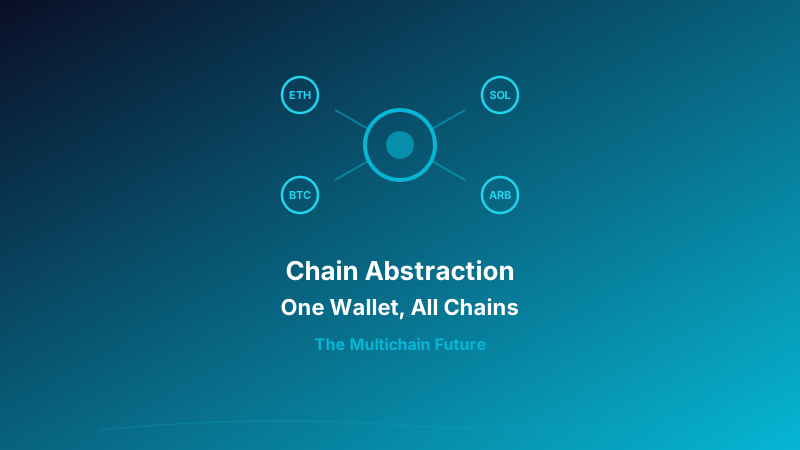
Chain abstraction is the solution: technology that lets you interact with any blockchain from a single account, using any token for gas, without ever thinking about which network you are on. You just use apps. The infrastructure handles everything else.
The Problem: Chain Fragmentation
The crypto industry has a fragmentation crisis. As of 2026, there are hundreds of active blockchains — Ethereum, Solana, dozens of L2 rollups, Cosmos chains, Bitcoin layers, and more. Each chain has:
- Its own native gas token
- Its own wallet connection process
- Its own block explorer
- Its own bridge infrastructure
- Its own liquidity pools
For developers, this means choosing which chain to deploy on (and often deploying on multiple chains). For users, this means managing assets scattered across networks, paying gas in different tokens, and navigating the risks of cross-chain bridges — which have been responsible for some of crypto's largest hacks (Ronin: $624M, Wormhole: $326M, Nomad: $190M).
The internet succeeded because users never think about TCP/IP, DNS resolution, or which server hosts a website. Chain abstraction aims to bring that same invisible infrastructure layer to crypto.
How Chain Abstraction Works
Chain abstraction is not a single technology — it is an umbrella term for several innovations working together:
1. Universal Accounts
Instead of having a separate wallet address on each chain, universal accounts give you a single identity that works across all networks. When you interact with an app on Arbitrum, your account on Ethereum provides the funds, and the infrastructure handles the cross-chain movement automatically.
Particle Network is building this through their Universal Accounts system. A single account, authenticated via social login or passkey, can hold and use assets on any supported chain. The user sees one unified balance.
NEAR Protocol approaches this through chain signatures — using NEAR accounts to sign transactions on any other chain (Ethereum, Bitcoin, Cosmos, etc.) without needing separate wallets.
2. Intent-Based Execution
Rather than constructing specific transactions on specific chains, users express intents — high-level goals like "swap 100 USDC for ETH at the best available price." Solvers then compete to fulfill that intent, routing through whatever chains and liquidity sources provide the best execution.
This is already happening with protocols like:
- Across Protocol: Uses intents and a network of relayers to fill cross-chain orders
- UniswapX: Uniswap's intent-based trading system that sources liquidity across DEXs and chains
- Socket Protocol: An aggregation layer that routes transactions across chains for optimal execution
3. Gas Abstraction
Gas abstraction ensures you never need to hold the native token of a chain to transact on it. If you have USDC on Base, you should be able to use an app on Arbitrum without first acquiring ARB or ETH.
This is achieved through paymaster contracts (from account abstraction) that accept payment in any token and convert it to the required gas token behind the scenes. Some apps sponsor gas entirely, making transactions free for users.
4. Unified Liquidity
The biggest practical problem of multi-chain crypto is fragmented liquidity. The USDC on Ethereum is not the same as USDC on Solana — they live in separate ecosystems with separate liquidity pools.
Chain abstraction protocols aim to create unified liquidity layers that aggregate assets across chains. When you trade on a chain-abstracted DEX, it pulls liquidity from every supported chain to give you the best price and lowest slippage.
Key Projects Building Chain Abstraction
Particle Network
Particle Network is arguably the most ambitious chain abstraction project. Their stack includes:
- Universal Accounts: One account across all chains, authenticated via social login
- Universal Liquidity: Automated cross-chain asset routing
- Universal Gas: Pay gas in any token on any chain
- Modular L1: A dedicated blockchain that coordinates the chain abstraction infrastructure
NEAR Protocol
NEAR's chain abstraction approach centers on chain signatures — using MPC (Multi-Party Computation) networks to allow NEAR accounts to control addresses on other blockchains. This means a single NEAR account can sign Bitcoin transactions, Ethereum transactions, and transactions on any other supported chain.
NEAR also introduced meta-transactions that allow relayers to pay gas on behalf of users, removing the need to hold NEAR tokens to use the network.
Connext (Everclear)
Connext rebranded to Everclear and is building a "clearing layer" for cross-chain transactions. Instead of each bridge independently handling cross-chain settlements (which fragments liquidity), Everclear nets out cross-chain flows globally — reducing the capital required and making cross-chain transactions cheaper and more efficient.
Socket Protocol
Socket provides developer tools for building chain-abstracted applications. Their Modular Order Flow Auction (MOFA) system lets developers specify intents that solvers compete to fulfill across chains.
LayerZero
LayerZero takes a messaging approach — providing a universal messaging protocol that lets smart contracts on different chains communicate directly. This enables cross-chain token transfers, governance, and composability without traditional bridges.
Chain Abstraction in Action: What It Feels Like
Imagine opening a crypto app in 2026 with full chain abstraction:
- Login: You authenticate with your fingerprint. No seed phrase, no network selection.
- Balance: You see one unified balance: "$4,230 total" — not "$1,200 on Ethereum, $890 on Arbitrum, $2,140 on Base."
- Swap: You want to swap USDC for a token that only has liquidity on Solana. You tap swap, confirm, done. You never knew Solana was involved.
- DeFi: You deposit into a lending protocol. The app automatically sources the best rate across all chains and deposits your funds there. You see "5.2% APY" — not "5.2% on Aave v3 on Optimism."
- Gas: You paid nothing for gas, or the app deducted a tiny amount of USDC. You never needed to buy ETH, SOL, or any other gas token.
This is the end state. We are not fully there yet, but every piece of the puzzle exists and is being assembled.
Challenges and Risks
Security
Cross-chain infrastructure has historically been crypto's weakest link. The more chains a system touches, the larger the attack surface. Chain abstraction protocols must be held to the highest security standards because they become single points of failure for multi-chain activity.
Latency
Cross-chain transactions are inherently slower than single-chain operations. When your swap involves routing through three chains, it takes longer than a simple on-chain swap. Solutions like intent-based execution mitigate this by using solvers who pre-fund transactions and settle later.
Centralization Risk
Many chain abstraction solutions rely on centralized relayers, solvers, or MPC networks. If these operators collude or go offline, users could lose access to their funds. Decentralizing these components without sacrificing speed is an ongoing challenge.
Complexity Under the Hood
While chain abstraction simplifies the user experience, it adds enormous complexity to the infrastructure layer. More complexity means more potential bugs, more attack vectors, and harder debugging when things go wrong.
Why Chain Abstraction Matters
The number of blockchains is increasing, not decreasing. The modular thesis means more rollups, more app-chains, and more specialized networks. Without chain abstraction, each new chain makes the user experience worse.
Chain abstraction is not optional — it is the only way the multi-chain future becomes usable by normal people. The internet analogy is apt: nobody chooses between AT&T's internet and Comcast's internet based on which websites they can access. They just use the internet. Crypto needs to reach the same point.
The projects building chain abstraction are constructing the invisible layer that makes hundreds of chains feel like one. When they succeed — and the trajectory suggests they will — the question of "which chain should I use?" will become as irrelevant as "which DNS server resolved that URL?"
You will just use crypto. And it will just work.
Tags
Ready to start trading?
Compare top cryptocurrency exchanges and find the best platform for you.
Compare Exchanges