
Crypto Options Trading: Complete Strategy Guide for 2026
Master crypto options trading with proven strategies for calls, puts, spreads, and Greeks. Learn risk management and platform selection for 2026.
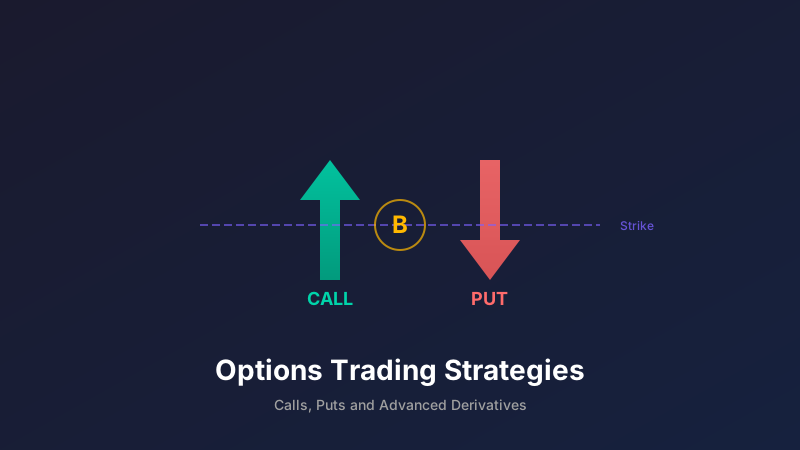
Crypto options represent one of the most powerful yet underutilized tools in a trader's arsenal. While perpetual futures dominate crypto derivatives volume, options offer something unique: asymmetric risk profiles where your maximum loss is defined upfront, but your potential gains can be unlimited. In a market as volatile as crypto, that's not just convenient—it's transformative.
Why Crypto Options Matter in 2026
The crypto options market has matured significantly since Bitcoin's first regulated options launched in 2019. Daily volumes now regularly exceed $2 billion, with open interest reaching all-time highs. Institutional players have arrived, sophisticated strategies that were once exclusive to traditional markets are now accessible to crypto natives, and the infrastructure has become robust enough to support complex multi-leg positions.
This guide will take you from understanding basic options mechanics to executing advanced strategies like iron condors and calendar spreads. Whether you want to generate income on holdings you already own, hedge against downside risk, or speculate on volatility itself, options provide the precision tools to execute your thesis.
Warning: Options are complex instruments that can result in total loss of premium. Approach this material with respect and start small.
TL;DR - The Quick Takeaways
- Options give you rights, not obligations: Call options let you buy, put options let you sell—but you're never forced to exercise. Your maximum loss is the premium you paid.
- Crypto options are European-style: Unlike stock options, most crypto options can only be exercised at expiration, not before. This affects pricing and strategy selection.
- The Greeks are your risk dashboard: Delta measures directional exposure, theta shows time decay, vega indicates volatility sensitivity. Monitor all three for every position.
- Start with covered calls and protective puts: These beginner-friendly strategies let you generate income or hedge existing holdings with defined risk.
- Deribit dominates but alternatives are growing: Deribit handles 85%+ of crypto options volume, but OKX and Binance offer competitive products with lower barriers to entry.
- Volatility is the hidden variable: Options aren't just bets on price direction—they're bets on how much price will move. Understanding implied volatility is crucial.
Table of Contents
- Understanding Crypto Options Fundamentals
- Essential Options Terminology
- Major Crypto Options Platforms
- Basic Options Strategies
- Advanced Options Strategies
- The Greeks Explained
- Risk Management for Options Trading
- Common Mistakes and How to Avoid Them
- Sources and Attribution
Understanding Crypto Options Fundamentals
Options are contracts that give you the right—but not the obligation—to buy or sell an underlying asset at a predetermined price before a specific date. In crypto, the underlying asset is typically Bitcoin or Ethereum, though altcoin options are expanding.
Calls vs Puts: The Two Building Blocks
Call Options grant the right to buy the underlying asset at the strike price. You buy calls when you're bullish—you believe the price will rise above your strike before expiration.
Example: Bitcoin trades at $95,000. You buy a call option with a $100,000 strike expiring in 30 days for a $2,000 premium. If Bitcoin rises to $110,000, your call is worth at least $10,000 ($110,000 - $100,000 strike). After subtracting your $2,000 premium, you profit $8,000—a 400% return. If Bitcoin stays below $100,000, your call expires worthless and you lose only the $2,000 premium.
Put Options grant the right to sell the underlying asset at the strike price. You buy puts when you're bearish or want to protect existing holdings.
Example: You own 1 Bitcoin at $95,000 and worry about a crash. You buy a put option with a $90,000 strike for $1,500. If Bitcoin drops to $70,000, your put lets you sell at $90,000—you've protected $20,000 of value for a $1,500 insurance cost. If Bitcoin rises, your put expires worthless but your Bitcoin holdings gained value.
Why Crypto Options Differ from Stock Options
Crypto options have unique characteristics that traditional traders must understand:
| Feature | Crypto Options | Stock Options |
|---|---|---|
| Settlement | Cash or physical | Usually physical |
| Exercise Style | European (at expiry) | American (anytime) |
| Trading Hours | 24/7/365 | Market hours only |
| Underlying Volatility | 60-100% annualized | 15-30% annualized |
Note: European-style exercise means you can only exercise your option at expiration, not before. This simplifies pricing but means you can't capitalize early on favorable moves by exercising—you'd need to sell the option itself.
The extreme volatility of crypto creates a fundamentally different options environment. Premiums are higher because the probability of large moves is higher. Strategies that work in traditional markets may need adjustment for crypto's wilder price action.
Essential Options Terminology
Mastering options vocabulary is non-negotiable. These terms appear in every platform interface, strategy discussion, and risk calculation.
Strike Price
The price at which you can buy (call) or sell (put) the underlying asset. Strike selection is one of the most important decisions in options trading.
Lower strike calls cost more but have higher probability of profit Higher strike calls cost less but need bigger moves to profit The same logic applies inversely to puts
Premium
The price you pay to buy an option or receive when selling one. Premium has two components:
Intrinsic Value: How much the option is worth if exercised right now. A $90,000 call when Bitcoin trades at $95,000 has $5,000 intrinsic value.
Extrinsic Value (Time Value): Everything else—the premium for time remaining and potential volatility. This portion decays to zero by expiration.
Expiration Date
When the option contract ends. Crypto options typically offer:
- Daily expiries (Deribit)
- Weekly expiries
- Monthly expiries (most liquid)
- Quarterly expiries
Shorter expirations have lower premiums but faster time decay. Longer expirations cost more but give your thesis more time to play out.
Moneyness: ITM, ATM, OTM
Options are categorized by their relationship to current price:
| Term | Call Option | Put Option |
|---|---|---|
| ITM (In The Money) | Strike < Current Price | Strike > Current Price |
| ATM (At The Money) | Strike = Current Price | Strike = Current Price |
| OTM (Out The Money) | Strike > Current Price | Strike < Current Price |
ITM options have intrinsic value and higher premiums ATM options have the highest time value and vega sensitivity OTM options are cheaper but need significant moves to profit
Open Interest and Volume
Open Interest: Total number of outstanding contracts. High OI indicates liquid strikes with tighter spreads.
Volume: Contracts traded that day. Spikes in volume at specific strikes can signal institutional activity or important price levels.
Warning: Low liquidity strikes have wide bid-ask spreads that can eat into profits. Stick to strikes with meaningful open interest, especially when starting out.
Major Crypto Options Platforms
The crypto options landscape is dominated by a few key players, each with distinct advantages and limitations.
Deribit: The Industry Standard
Deribit handles approximately 85-90% of all crypto options volume. It's the platform serious options traders use.
Strengths:
- Deepest liquidity and tightest spreads
- Most strike prices and expiration dates
- Portfolio margining for efficient capital use
- Block trading for large orders
Considerations:
- No U.S. customers (offshore entity)
- 0.03% maker fee / 0.03% taker fee on options
- Requires crypto deposit (no fiat)
- More complex interface for beginners
Minimum Trade Size: 0.1 BTC notional for Bitcoin options
OKX: The Strong Alternative
OKX has emerged as Deribit's main competitor with competitive liquidity and a more accessible interface.
Strengths:
- Growing liquidity, especially for ETH options
- Lower fees (0.02% maker / 0.03% taker)
- More altcoin options available
- Better mobile experience
Considerations:
- Lower overall volume than Deribit
- Some strikes less liquid
- Also not available in U.S.
Binance Options
Binance offers options products integrated into their main exchange.
Strengths:
- Familiar interface for existing Binance users
- Good for smaller position sizes
- Short-term options (10 min to 1 day)
Considerations:
- Simpler product (primarily for directional bets)
- Less sophisticated strategy support
- Limited strike selection
CME Bitcoin Options (Regulated)
For U.S. institutional players, CME offers regulated Bitcoin options.
Strengths:
- Fully regulated (U.S. legal)
- Cash-settled
- Institutional-grade infrastructure
Considerations:
- Minimum 5 BTC contract size
- Only monthly expirations
- Market hours only (not 24/7)
- Higher capital requirements
Basic Options Strategies
These foundational strategies are where every options trader should begin. They offer defined risk, straightforward mechanics, and practical utility.
Long Call: Bullish with Limited Risk
When to use: You're bullish on price and want leveraged exposure with defined downside.
Mechanics: Buy a call option at your chosen strike and expiration.
Example Scenario:
- Bitcoin: $95,000
- You buy 1 BTC call at $100,000 strike, 30 days to expiry
- Premium paid: $3,500
Outcomes:
- Bitcoin at $110,000: Option worth $10,000, profit = $6,500 (186% return)
- Bitcoin at $100,000: Option expires worthless, loss = $3,500 (100% of premium)
- Bitcoin at $90,000: Option expires worthless, loss = $3,500 (same as above)
Key insight: Your loss is capped at the premium regardless of how far price falls. That's the asymmetry options provide.
Long Put: Bearish with Limited Risk
When to use: You're bearish on price or want portfolio insurance.
Mechanics: Buy a put option at your chosen strike.
Example Scenario:
- Ethereum: $3,400
- You buy 10 ETH puts at $3,200 strike, 14 days to expiry
- Premium paid: $800 total
Outcomes:
- ETH at $2,800: Puts worth $4,000 ($400 x 10), profit = $3,200
- ETH at $3,400+: Puts expire worthless, loss = $800
Covered Call: Generate Income on Holdings
When to use: You own crypto, expect sideways to slightly bullish movement, and want to generate income.
Mechanics: Own the underlying asset + sell a call option against it.
Example Scenario:
- You own 1 BTC at $95,000
- You sell 1 BTC call at $105,000 strike, 30 days out
- Premium received: $2,000
Outcomes:
- BTC stays below $105,000: Keep your Bitcoin AND the $2,000 premium
- BTC rises to $115,000: Your Bitcoin gets "called away" at $105,000. You keep the premium but miss gains above $105,000
Note: Covered calls cap your upside but provide consistent income in sideways markets. Many long-term holders use this to generate yield on assets they'd hold anyway.
Cash-Secured Put: Get Paid to Set Limit Orders
When to use: You want to buy crypto at a lower price and get paid while waiting.
Mechanics: Sell a put option while holding enough cash to buy the asset if assigned.
Example Scenario:
- Bitcoin: $95,000
- You'd happily buy at $85,000
- You sell a $85,000 put, 45 days out
- Premium received: $1,200
Outcomes:
- BTC stays above $85,000: Put expires worthless, you keep $1,200
- BTC drops to $80,000: You buy BTC at $85,000 (your target price) and keep the premium. Effective entry = $83,800
Why this works: You're getting paid to commit to buying at a price you wanted anyway. If the price never drops there, you pocket the premium and try again.
Protective Put: Portfolio Insurance
When to use: You hold crypto and want downside protection without selling.
Mechanics: Own the underlying asset + buy a put option.
Example Scenario:
- You own 5 ETH at $3,400 each ($17,000 total)
- You buy 5 ETH puts at $3,000 strike, 60 days out
- Premium paid: $500 total
Outcomes:
- ETH crashes to $2,000: Your puts are worth $5,000 ($1,000 x 5). Net loss = $2,000 - $500 premium - $5,000 put gain = much smaller than unhedged
- ETH rises to $4,000: Puts expire worthless ($500 loss) but your ETH gained $3,000
This is genuine insurance. You pay a premium to limit catastrophic loss.
Advanced Options Strategies
Once you've mastered the basics, these multi-leg strategies offer more nuanced risk/reward profiles for specific market views.
Straddle: Betting on Volatility
When to use: You expect a big move but don't know which direction. Major events (ETF decisions, protocol upgrades, FOMC meetings) are typical triggers.
Mechanics: Buy a call AND a put at the same strike (usually ATM) with the same expiration.
Example Scenario:
- Bitcoin: $95,000
- You buy 1 BTC $95,000 call for $4,000
- You buy 1 BTC $95,000 put for $3,800
- Total premium: $7,800
Breakeven Points:
- Upper: $95,000 + $7,800 = $102,800
- Lower: $95,000 - $7,800 = $87,200
Outcomes:
- BTC moves to $110,000: Call worth $15,000, put worthless. Profit = $7,200
- BTC moves to $80,000: Put worth $15,000, call worthless. Profit = $7,200
- BTC stays at $95,000: Both expire worthless. Loss = $7,800
Warning: Straddles are expensive because you're buying two options. You need significant movement to profit. If implied volatility is already high (priced into premiums), the move required may be unrealistic.
Strangle: Cheaper Volatility Bet
When to use: Same as straddle but you want to spend less premium by accepting wider breakevens.
Mechanics: Buy an OTM call AND an OTM put with the same expiration.
Example Scenario:
- Bitcoin: $95,000
- You buy 1 BTC $100,000 call for $2,500
- You buy 1 BTC $90,000 put for $2,300
- Total premium: $4,800
Breakeven Points:
- Upper: $100,000 + $4,800 = $104,800
- Lower: $90,000 - $4,800 = $85,200
Strangles require bigger moves than straddles but cost less upfront.
Bull Call Spread: Defined Risk Bullish Trade
When to use: You're moderately bullish and want to reduce cost versus a naked long call.
Mechanics: Buy a call at a lower strike + sell a call at a higher strike (same expiration).
Example Scenario:
- Bitcoin: $95,000
- Buy 1 BTC $95,000 call for $4,500
- Sell 1 BTC $105,000 call for $1,500
- Net debit: $3,000
Outcomes:
- Max profit: $10,000 spread width - $3,000 cost = $7,000 (if BTC > $105,000)
- Max loss: $3,000 (if BTC < $95,000)
- Breakeven: $98,000
Trade-off: You cap your upside at $105,000 but significantly reduce your cost basis.
Bear Put Spread: Defined Risk Bearish Trade
When to use: You're moderately bearish and want cheaper exposure than a naked put.
Mechanics: Buy a put at a higher strike + sell a put at a lower strike.
Example Scenario:
- Ethereum: $3,400
- Buy 10 ETH $3,400 puts for $1,200
- Sell 10 ETH $3,000 puts for $600
- Net debit: $600
Outcomes:
- Max profit: ($400 x 10) - $600 = $3,400 (if ETH < $3,000)
- Max loss: $600 (if ETH > $3,400)
- Breakeven: $3,340
Iron Condor: Profit from Range-Bound Markets
When to use: You expect price to stay within a defined range through expiration.
Mechanics: Sell an OTM call spread + sell an OTM put spread simultaneously.
Example Scenario:
- Bitcoin: $95,000
- Sell $100,000 call / Buy $105,000 call (collect $1,000 net)
- Sell $90,000 put / Buy $85,000 put (collect $800 net)
- Total credit received: $1,800
Outcomes:
- Max profit: $1,800 (if BTC stays between $90,000-$100,000)
- Max loss: $5,000 - $1,800 = $3,200 (if BTC breaks either wing)
- Breakeven: $88,200 and $101,800
Note: Iron condors thrive in low volatility environments. In crypto's typically volatile markets, give yourself wider wings or shorter timeframes.
Calendar Spread: Trading Time Decay Differentials
When to use: You expect near-term stability but longer-term movement, or want to profit from different decay rates.
Mechanics: Sell a near-term option + buy a longer-term option at the same strike.
Example Scenario:
- Bitcoin: $95,000
- Sell 1 BTC $95,000 call expiring in 7 days for $1,800
- Buy 1 BTC $95,000 call expiring in 30 days for $4,200
- Net debit: $2,400
The near-term option decays faster. If Bitcoin stays near $95,000, the short option expires worthless while your long option retains value.
The Greeks Explained
The Greeks are sensitivity metrics that quantify how your options position responds to changes in price, time, volatility, and interest rates. Monitoring them is essential for managing risk.
Delta: Directional Exposure
What it measures: How much the option price changes for a $1 move in the underlying.
Range: -1 to +1 (or expressed as -100 to +100)
| Option Type | Delta Range | Interpretation |
|---|---|---|
| Long Call | +0.01 to +1.0 | Gains when price rises |
| Long Put | -0.01 to -1.0 | Gains when price falls |
| ATM Option | ~0.50 or ~-0.50 | Moves roughly half as much as underlying |
Practical Use:
- Delta also approximates probability of expiring ITM
- A 0.30 delta call has roughly 30% chance of profit
- Portfolio delta tells you net directional exposure
Example: You hold 3 BTC calls with 0.40 delta each. Your position has 1.2 delta exposure—equivalent to holding 1.2 BTC directionally.
Theta: Time Decay
What it measures: How much value your option loses each day, all else equal.
Always negative for long options (they lose value over time) Always positive for short options (you benefit from decay)
The Decay Curve: Theta accelerates as expiration approaches. An option loses more value in its final 7 days than in its first 30 days.
| Days to Expiry | Relative Decay Speed |
|---|---|
| 60+ days | Slow (minimal daily impact) |
| 30 days | Moderate |
| 7 days | Fast |
| 1-2 days | Extreme |
Practical Use:
- If you're long options, time is your enemy—you need the move to happen quickly
- If you're short options (selling), time decay works in your favor
- Theta is highest for ATM options
Example: Your $95,000 BTC call has theta of -$150. You lose $150 per day just from time passing, even if Bitcoin doesn't move.
Gamma: Rate of Delta Change
What it measures: How much delta changes for a $1 move in the underlying.
Why it matters: Gamma tells you how quickly your directional exposure can shift.
High gamma (ATM options near expiry) means delta changes rapidly—your position can flip from profitable to unprofitable quickly.
Low gamma (deep ITM/OTM or far-dated options) means more stable, predictable delta.
Practical Use:
- Gamma risk is highest in the final days before expiration
- Market makers actively hedge gamma exposure
- Short gamma positions can blow up during volatile moves
Vega: Volatility Sensitivity
What it measures: How much the option price changes for a 1% change in implied volatility.
Long options have positive vega—they benefit from volatility increasing Short options have negative vega—they benefit from volatility decreasing
Practical Use:
- Buy options when IV is low (options are "cheap")
- Sell options when IV is high (options are "expensive")
- Vega is highest for ATM, longer-dated options
Example: Your option has vega of $200. If implied volatility rises from 60% to 65%, your option gains $1,000 ($200 x 5) in value—even if the underlying price doesn't move.
Note: In crypto, volatility itself is volatile. Implied volatility can swing 20-30% in a single day during major events. Vega exposure matters more in crypto than traditional markets.
Putting Greeks Together
Consider a position:
- Long 1 BTC $95,000 call
- Delta: +0.52
- Theta: -$180/day
- Gamma: +0.02
- Vega: +$300
This tells you:
- Moderately bullish exposure (0.52 BTC equivalent)
- Losing $180/day to time decay
- Delta will increase by 0.02 for every $1,000 BTC rises
- Will gain $300 if implied volatility rises 1%
Your job is balancing these sensitivities against your market thesis and risk tolerance.
Risk Management for Options Trading
Options amplify both profits and losses through leverage. Robust risk management isn't optional—it's survival.
Position Sizing: The 1-2% Rule
Never risk more than 1-2% of your trading capital on any single options trade. For options, "risk" means the maximum possible loss.
Example:
- Trading capital: $50,000
- Maximum risk per trade: $500-$1,000
- If buying a $2,000 premium option, you're risking 4%—too much
For defined-risk strategies (spreads, long options), your max loss is clear. For undefined-risk strategies (naked short options), calculate the loss at reasonable adverse price levels.
Portfolio-Level Risk Management
| Risk Metric | Conservative | Moderate | Aggressive |
|---|---|---|---|
| Max allocation to options | 5-10% | 10-20% | 20-30% |
| Max single position | 1% | 2% | 3% |
| Max delta exposure | 0.3 portfolio | 0.5 portfolio | 0.7 portfolio |
Managing Theta Decay
If you're long options:
- Use longer expirations (60+ days) to slow decay
- Take profits early rather than holding to expiration
- Roll positions before the final 14 days
If you're short options:
- Manage at 50% profit rather than holding to expiration
- Avoid earnings/events that could trigger explosive moves
- Size positions for the worst-case gamma exposure
Volatility-Adjusted Sizing
High implied volatility means options are expensive. Adjust sizing accordingly:
IV Percentile > 70: Options are expensive—smaller position sizes or consider selling IV Percentile 30-70: Normal environment IV Percentile < 30: Options are cheap—potentially larger position sizes
Exit Rules
Define exits before entering any trade:
- Profit targets: Take profits at 50-100% gains for long options
- Stop losses: Exit if option loses 50% of value (debatable—options can recover)
- Time stops: Exit if thesis hasn't played out with 14 days remaining
- Delta stops: Exit if position delta exceeds your risk tolerance
Warning: The most common mistake is "hoping" for recovery. Options have finite lifespans—waiting too long often means total loss instead of partial loss.
Hedging with Options
Options themselves are hedging tools:
Protective puts on long crypto positions define your maximum loss Collar strategies (long put + short call) create a price range with limited risk Tail hedges are cheap, far OTM puts that pay off in crashes
Consider allocating 1-3% of portfolio value annually to tail protection—it's insurance against black swan events.
Common Mistakes and How to Avoid Them
Mistake 1: Ignoring Implied Volatility
The error: Buying calls before a known event because "price will move."
The reality: Everyone knows about scheduled events. Implied volatility is already elevated, making options expensive. Even if you're right about direction, IV crush after the event can destroy your position.
The fix: Compare current IV to historical IV. Use IV percentile. Avoid buying options when IV > 70th percentile unless you have strong conviction.
Mistake 2: Buying Weekly Options for "Cheap" Leverage
The error: Buying far OTM weekly options because they cost $50 instead of $500.
The reality: Those $50 options have 5-10% chance of profit. You need massive moves in short timeframes. The math rarely works in your favor.
The fix: Pay up for longer expirations (45+ days) and closer-to-the-money strikes. Higher absolute cost but much better probability.
Mistake 3: Selling Naked Options Without Understanding Tail Risk
The error: Selling far OTM puts because "Bitcoin will never drop 40% in a week."
The reality: It can and has. March 2020. May 2021. November 2022. Crypto moves are extreme, and naked short options have theoretically unlimited loss.
The fix: Always use spreads to define risk. Never sell naked options without deep understanding of margin requirements and potential losses.
Mistake 4: Holding to Expiration
The error: Waiting for your option to "come back" as expiration approaches.
The reality: Time decay accelerates exponentially. A struggling position rarely recovers in the final days.
The fix: Have predefined exit rules. Roll or close positions with 14+ days remaining. Take the loss and redeploy capital.
Mistake 5: Over-Leveraging
The error: Putting 50% of capital into options because "I'm really sure about this trade."
The reality: Even correct directional calls can lose money due to timing, IV, or theta. Concentration kills.
The fix: Never allocate more than 20% of trading capital to options. Diversify across strikes, expirations, and strategies.
Mistake 6: Ignoring Liquidity
The error: Trading exotic strikes with no open interest to get "perfect" positioning.
The reality: Wide bid-ask spreads mean you overpay to enter and get underpaid to exit. Slippage destroys edge.
The fix: Stick to strikes within 10-15% of current price with open interest > 100 contracts. Accept "good enough" strikes for liquid execution.
Mistake 7: Not Paper Trading First
The error: Going live immediately because paper trading is "boring."
The reality: Options mechanics are complex. Mistakes are expensive. Real money adds emotional distortion.
The fix: Paper trade for at least 2-3 months. Track every trade. Understand why positions moved the way they did. Graduate to real money only when consistently profitable.
Building Your Options Trading Plan
Step 1: Define Your Objective
- Income generation: Focus on covered calls and cash-secured puts
- Speculation: Use defined-risk directional strategies
- Hedging: Use protective puts and collars
- Volatility trading: Use straddles, strangles, and calendar spreads
Step 2: Choose Your Platform
Start with the platform matching your needs:
- Deep liquidity: Deribit
- Simpler products: Binance Options
- Growing alternative: OKX
- Regulated access: CME (if institutional/US-based)
Step 3: Start Small
Your first 50 options trades are tuition. Size accordingly:
- Maximum 0.5% portfolio risk per trade
- Single-leg strategies only (long calls, long puts)
- Monthly expirations only
- ATM or slightly OTM strikes only
Step 4: Track Everything
Maintain a trading journal with:
- Entry thesis and expected outcome
- Greeks at entry
- Actual outcome and P&L
- What you learned
Step 5: Graduate to Complexity
Only after 6+ months of profitable single-leg trading:
- Add spreads
- Explore shorter expirations
- Consider selling strategies
- Build multi-leg positions
Sources and Attribution
This guide synthesizes information from multiple authoritative sources:
- Deribit exchange documentation and options specifications
- CME Group Bitcoin and Ethereum options product guides
- Academic research on options pricing models (Black-Scholes, binomial models)
- OKX and Binance options trading documentation
- Historical volatility data from Skew Analytics and The Block
- "Options, Futures, and Other Derivatives" by John C. Hull
- CFA Institute curriculum on derivative instruments
- On-chain options data from Deribit Insights and Amberdata
Market statistics and volume figures reflect data available through Q4 2025 and early 2026 market conditions. Options trading involves substantial risk—verify current specifications directly with your chosen platform before trading.
What's Next?
Disclaimer: This guide is for educational purposes only and should not be considered financial advice. Cryptocurrency investments carry significant risk. Always do your own research before making investment decisions.